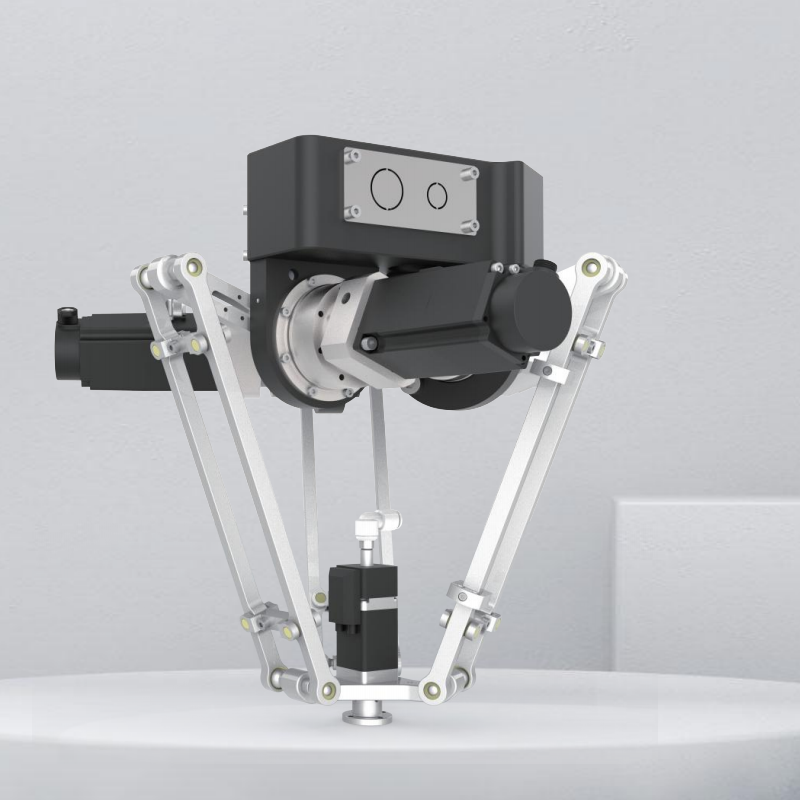
Recommended Product: JORI 3kg Delta Robot Arm with IP54 Protection
The JORI 3 kg delta robot arm with IP54 protection is recommended for buyers who need a compact, high-speed pick-and-place platform with strong integration flexibility. It can be configured for vision-guided picking, conveyor tracking, labeling, carton packing and lid application, and it can be supplied with an in-house controller and 2D/3D vision options developed by JORI Intelligent Technology Co., Ltd.
Instead of buying an arm only, global buyers can evaluate the robot together with the end effector, controller, vision, safety logic and line communication. This single-source approach reduces integration risk because the robot supplier and automation team work from the same engineering baseline.
| Specification Area |
What Buyers Should Verify |
| Payload |
3 kg rated payload. Confirm part weight, gripper or vacuum tooling weight, hose and cable drag, acceleration and center-of-gravity. Keep a margin for real production variation. |
| Protection |
IP54 protection for dust and water splash. Confirm whether your cleaning method is low-pressure splash or high-pressure washdown. Higher protection and hygienic design can be reviewed if needed. |
| Repeatability |
0.08 mm class repeatability for the catalogue model. Final accuracy must be checked against product tolerance, vision alignment and end-effector design. |
| Axes and motion |
2/3/4-axis options for pick-and-place, orientation, rotation and labeling tasks. Select the axis configuration according to how the product must be oriented at placement. |
| Controller and vision |
In-house controller, PLC-ready communication, 2D/3D vision options and conveyor tracking. Share PLC brand, I/O list, safety logic and line protocol early. |
| Speed |
High-speed pick-and-place and labeling cells can reach high cycle rates; some applications run up to approximately 120 pieces per minute. The final rate depends on stroke, mass, product presentation and vision time. |
| Installation |
Overhead or floor-mounted frame, compact work envelope, cable routing, guarding and maintenance access. Confirm the robot envelope against your conveyor and packaging machine layout. |
| OEM and integration |
Custom end effectors, buyer labels, controller integration, machine-builder support and automated system integration are available for qualified projects. |
Figures reflect current catalogue configuration options. Final specifications, cycle time and protection level must be confirmed for each application.
Need a configuration review? Send product photos, part weight, required cycle time and line layout to
info@joribot.com, or request the catalogue to compare models and integration options.
Get Catalog
Recommended Configuration by Application
Food & beverage packagingIP54 delta robot, stainless or easy-clean end effector, vision-guided picking and conveyor tracking for fast secondary packaging.
Daily chemical and wet wipes4-axis delta configuration for lid placement, carton packing and small-part feeding around high-speed packaging machines.
Pharmaceutical and medicalRepeatable pick-and-place for vials, blisters, pouches and cartons with documented controller settings and changeover procedures.
OEM machine buildersRobot, controller and vision integrated into your machine frame with agreed I/O, safety logic, labeling and acceptance tests.
Product Procurement Trends Global Buyers Are Watching
Global procurement for industrial delta robots is changing. Buyers are not only asking for a robot model and a price; they are asking how quickly a pilot cell can be validated, how the supplier will support integration and how total cost will behave over five to seven years. These are the main trends shaping purchase decisions for the 3kg payload industrial delta robot arm with IP54 protection.
1. Pilot-cell purchasing before line-wide rollout
Rather than committing to a full packaging line at once, many buyers start with one robot cell to validate cycle time, product handling, cleaning and operator acceptance. A minimum order quantity of one set makes this approach practical. After the pilot cell proves stable output, the buyer can standardize the same robot platform across additional lines.
2. Total cost of ownership over lowest initial price
Procurement teams are comparing spare parts, service response, controller support, training, documentation and uptime—not just the robot price. A lower-cost arm that requires a third-party controller and vision system can become more expensive when integration issues arise. Buyers increasingly prefer a supplier who can support the robot, controller, vision and integration in one communication chain.
3. Single-source controller and vision integration
High-speed delta cells depend on tight coordination between the robot, vision, conveyor encoder, PLC and packaging machine. When the robot, controller and vision come from different suppliers, responsibility can become fragmented. JORI develops controllers and 2D/3D vision in-house, giving buyers one accountable source for the core motion and vision platform.
4. Custom end effectors and faster changeover
As SKU counts increase, buyers want quick-change grippers, vacuum tooling and adjustable changeover settings. A 3 kg payload robot can handle many tools, but every tool must be included in the payload and center-of-gravity calculation. Suppliers who support custom end effectors and provide clear changeover documentation have an advantage.
5. Verified suppliers and export documentation
International buyers are more careful about supplier verification. They review factory profiles, certifications, transaction history and technical documentation before releasing a purchase order. ISO 9001 quality management, onsite verification, patents and clear export terms help reduce procurement risk. JORI supports buyers with OEM service, design service, trade capacity information and documented quality management.
6. Shorter lead times and responsive engineering support
Packaging projects often run on tight installation windows. Buyers want fast replies, clear lead times and engineering support before the robot arrives. JORI maintains a published response rate of 97.06% with a typical response time of 2 hours or less, so technical questions can be addressed while the project is still in the planning stage.
Product Development Trends for IP54 Delta Robots
The next generation of 3kg IP54 delta robots will be easier to commission, easier to clean and more deeply connected to production data. For buyers, these trends matter because they affect changeover time, engineering cost and long-term flexibility.
- AI-assisted vision: better random picking, orientation detection and defect screening with less fixture engineering.
- Digital twin and offline programming: simulate the robot cell before shipment to reduce onsite commissioning time.
- Modular hygienic design: smoother surfaces, sealed cable routing and higher protection options for food and pharmaceutical applications.
- Integrated motion and vision: tighter synchronization between robot, camera, conveyor encoder and packaging machine.
- IoT and predictive maintenance: remote monitoring of cycle counts, motor temperature, vibration and maintenance intervals.
- Faster changeover: recipe-driven settings for different products, tooling and packaging formats.
- Energy and footprint efficiency: lighter arms, optimized motion profiles and compact controllers that fit inside existing machines.
These development trends point in the same direction: the delta robot is becoming a more complete production module rather than a standalone arm. Buyers should ask suppliers how the controller handles recipe management, how vision data is logged, how safety is integrated and how future models remain compatible with existing line controls.
Buyer's Checklist Before You Request a Quotation
A clear technical brief helps suppliers recommend the right 3kg payload industrial delta robot arm with IP54 protection and avoid over- or under-specification.
- Product photos, dimensions, weight and center of gravity.
- Required cycle time and actual conveyor speed.
- Required placement orientation and accuracy tolerance.
- Gripper or vacuum tooling concept, including hose and cable weight.
- Environmental conditions: dust, humidity, cleaning method, temperature and room constraints.
- Vision requirements: fixed pick, random pick, inspection or conveyor tracking.
- PLC brand, communication protocol, I/O list and safety logic.
- Line layout, robot mounting method and available maintenance access.
- Voltage, air supply, guarding and compliance requirements.
- Target delivery date, installation support needs and acceptance test criteria.