Compact Latent AGV for Narrow Aisle Warehouse Transportation
A buyer-focused guide to low-profile under-cart transport, laser SLAM navigation, fleet planning, procurement trends, and practical supplier evaluation for global warehouse projects.
Move Carts, Not Aisles: Fit Automation Into Existing Space
A latent AGV travels beneath carts and carriers, helping warehouses reduce manual pushing without reconstructing every aisle or adding bulky equipment to the floor.
Founded in 2012, JORI develops robot hardware, controllers and vision systems in-house and supports global buyers with project evaluation, engineering review and OEM options.
What Is a Compact Latent AGV — and Why Do Narrow Aisles Change the Specification?
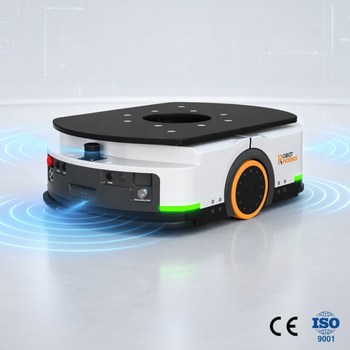
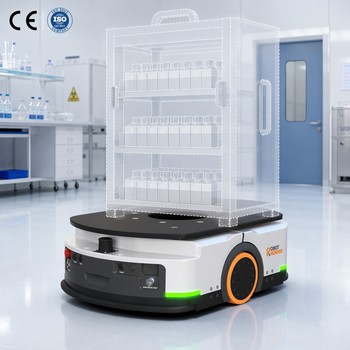
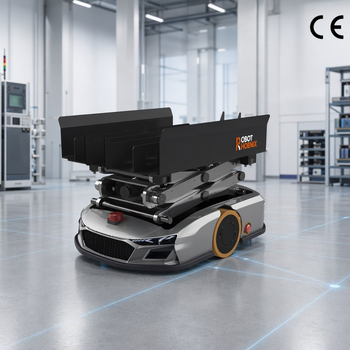
A compact latent AGV for narrow aisle warehouse transportation is not simply a smaller automated guided vehicle. In most projects, “latent” describes a low-profile mobile robot that travels underneath a cart, trolley, rack carrier or custom load platform, engages with it, lifts it slightly and moves it through the warehouse. Because the AGV body sits below the load rather than beside it, the combined vehicle-and-load footprint can remain close to the cart width. That is valuable in existing buildings where aisle width, turning clearance and traffic congestion cannot be expanded without major construction.
Global buyers often begin with a simple question: can we automate horizontal transport without rebuilding the warehouse? For narrow aisle operations, the answer depends on engineering details that are easy to miss in a brochure: under-cart clearance, lifting height, load center, wheel material, floor condition, docking tolerance, safety sensor fields, Wi-Fi coverage, charging strategy and the way manual traffic will mix with robot traffic. A compact latent AGV is therefore best specified as a system — robot, top module, navigation, fleet management, safety and service — rather than as a standalone vehicle.
JORI Intelligent Technology Co., Ltd. approaches this product category from an industrial robotics background. Since 2012, the company has developed delta robots, SCARA robots, silicon wafer robots, AGV/AMR platforms, controllers and 2D/3D vision in-house. For procurement teams, that matters because a latent AGV project rarely stops at the chassis. It continues into load handling, communication with warehouse systems, operator safety and long-term spare-parts support.
Low-profile under-cart transport concept
Laser SLAM navigation without floor tape
Fleet management for mixed traffic
OEM, custom top modules and integration
Recommended Product
JORI Compact Latent AGV for Narrow Aisle Warehouse Transportation
A low-profile mobile robot concept for under-cart transport, flexible logistics and scalable fleet deployment in space-constrained warehouses.
JORI Compact Latent AGV Platform
Low-Profile Transport That Works Beneath Carts and Carriers
Designed for narrow aisle material flow and under-cart handling
Laser SLAM navigation with flexible route changes
Fleet management for task dispatch and multi-vehicle traffic
Ensures the AGV is part of a material-flow system rather than an isolated robot.
06Safety
Pedestrian density, blind corners, speed zones, emergency-stop points and local risk-assessment requirements.
Supports safe mixed traffic and helps procurement compare suppliers on a like-for-like basis.
07Service
Spare-parts list, remote support, commissioning plan, operator training and escalation process.
Protects uptime after installation and lowers lifecycle risk for overseas buyers.
A practical fleet starting point: required vehicles = peak trips per hour ÷ effective trips per vehicle per hour × redundancy factor. Use 1.15–1.30 for congestion, charging and peak variability, then validate with a layout simulation.
Future Procurement Trends
How Global Buyers Will Purchase Narrow Aisle AGVs in the Next Buying Cycle
Procurement decisions are moving from “Can a robot move a cart?” to “Can this fleet improve flow, safety and uptime with measurable ROI?”
01
Micro-Fulfillment Priorities
Urban warehouses need more throughput per square meter. Compact latent AGVs appeal because they add automation without widening aisles or reserving large charging areas.
02
Labor Flexibility
Buyers increasingly automate repetitive cart pushing and long-distance transfers to stabilize output during labor shortages and shift changes, while redeploying staff to picking and exception handling.
03
Phased ROI
Instead of single large orders, procurement teams test two to four vehicles on one route, validate cycle time and uptime, then scale. Suppliers must provide transparent assumptions and acceptance criteria.
04
Integration-First RFQs
WMS, MES, ERP and WCS integration is now part of the RFQ. Buyers ask how task dispatch, call systems, elevator control and error recovery are handled before they compare vehicle prices.
05
Safety Verification
Global buyers expect risk assessments, sensor-field documentation, speed-zone planning and operator training. A low-profile design must be paired with robust obstacle detection and clear traffic rules.
06
Lifecycle Cost Focus
Fuel and maintenance assumptions are being replaced by battery health, charger strategy, spare-parts availability and remote support. The lowest purchase price is not always the lowest total cost.
07
Global Supplier Due Diligence
Overseas buyers are checking factory verification, ISO 9001, export experience, reference projects and response speed. These are now common pre-qualification items before technical review.
08
Scalable Fleet Architecture
Buyers want a pilot that can grow into a fleet. Fleet management, route editing, charging rules and traffic-control capacity should be evaluated at the pilot stage, not added later.
Product Development Trends
Where Compact Latent AGV Technology Is Heading
The next generation of latent AGVs will be judged less on the chassis alone and more on how intelligently it connects to loads, people, software and service.
Lower profile, higher payload. Warehouse layouts are precious. Engineering teams are optimizing drive layout, structural stiffness and lifting mechanisms so that a low-profile AGV can handle heavier carts while preserving stability and safety. Buyers should ask for the load center and lifting height at the actual payload, not only the maximum payload on a specification sheet.
Sensor fusion and dynamic navigation. Laser SLAM remains central, but future systems combine LiDAR, vision, inertial data and optional floor markers to handle glass, reflections, dust, pallets protruding into aisles and mixed pedestrian traffic. The goal is fewer route restrictions and faster recovery when an obstacle blocks the path.
Modular top modules. A latent AGV may need to lift a cart, tow a train, dock with a conveyor or rotate a platform. Modular top modules let buyers adapt one platform to multiple load types, which improves asset utilization and reduces the risk of a single-purpose fleet.
Fleet orchestration and interoperability. Warehouses are increasingly multi-robot environments. Fleet software must manage charging, traffic, task priority, elevator and door handshakes, fault handling and data logs. Open interfaces and support for common integration patterns are becoming procurement requirements rather than nice-to-have features.
Safety intelligence and remote commissioning. Digital models and simulation help validate route width, turning points and charging locations before shipment. During installation, remote commissioning and guided acceptance tests reduce travel and downtime for overseas projects.
Low-profile mechanical design
Laser SLAM plus safety sensing
Modular lifting and docking
Fleet-management integration
Battery and charging optimization
Remote diagnostics and service
Review the FactorySee robot production, testing and integration capabilities
Experience · Expertise · Authority · Trust
Why JORI Intelligent Technology Co., Ltd. Is a Credible Compact AGV Partner
Buyers need more than a product photo. They need a manufacturer with in-house engineering, verified company information and a practical path from inquiry to commissioning.
JORI Intelligent Technology Co., Ltd. was founded in 2012 and is located in Jinan, Shandong Province, China. The company specializes in industrial robot R&D and manufacturing, controller and vision system development, OEM support and automated system integration. Its product and technology portfolio includes delta robots, SCARA robots, silicon wafer robots, AGV/AMR platforms, 2D/3D vision and robot controllers.
For a compact latent AGV project, this breadth is useful. The vehicle must move, sense, dock, lift, communicate and support maintenance. JORI’s self-developed controllers, vision capabilities and automation integration experience allow project discussions to cover the whole material-flow cell, not only the AGV chassis. The company also supports OEM service, design service and buyer-label options for machine builders and system integrators.
JORI’s published company profile shows 501–1,000 employees, annual revenue in the US$10 million–US$50 million range, a response rate of 97.06% and a typical response time of 2 hours or less. The company has ISO 9001 quality management, onsite verification and export experience across Asia, Europe, the Americas and other regions. Buyers can request company documents, product information and technical clarification directly by email at info@joribot.com.
Founded in 2012 with in-house R&D
ISO 9001 quality management
Onsite-verified manufacturer profile
OEM, design and buyer-label support
97.06% response rate, ≤2 hours average
One accountable source for robot, controller and vision
Compact Latent AGV Questions Global Buyers Ask Before Inquiring
What is a compact latent AGV for narrow aisle warehouse transportation?
It is a low-profile autonomous mobile robot designed to travel beneath carts, trolleys or custom carriers and transport them through narrow aisles. Because the robot body sits under the load, the combined footprint can remain compact, helping existing warehouses add automation without widening every aisle.
Can a latent AGV work under our existing carts and trolleys?
Often it can, but the cart interface must be checked before quotation. Provide under-cart clearance, lifting point height, cart weight, load center, wheel type, floor condition, latch or pin details, and drawings or photos. JORI engineers can review the interface and recommend a lifting module or modification.
Does a compact latent AGV need magnetic tape or QR codes on the floor?
JORI laser SLAM AGV platforms are designed for natural navigation and do not require magnetic tape for normal route following. Whether additional localization aids are needed depends on docking accuracy, ceiling structure, glass, pedestrian density and load-handling tolerances. These points are reviewed during technical evaluation.
What payload should I specify for narrow aisle transport?
Start with the actual cart or carrier weight plus the load, then add a safety margin for uneven loading. Also state the load center and lifting height. A payload figure alone is not enough: the robot’s stability and lifting performance must be evaluated with the real load shape and travel route.
How many latent AGVs do we need?
Use a preliminary calculation: peak trips per hour divided by effective trips per vehicle per hour, multiplied by a redundancy factor. The factor should account for charging, congestion, shift peaks and recovery time. A pilot on one route is the most reliable way to validate cycle time before scaling to a fleet.
Can the AGV integrate with our WMS, MES, ERP or PLC equipment?
Integration scope should be defined in the RFQ. Typical requirements include task dispatch, call buttons, traffic lights, door or elevator handshakes, error reporting and data logs. JORI’s automation integration experience allows the project to be discussed as a material-flow system rather than an isolated robot purchase.
How is safety managed in mixed manual and robot traffic?
Safety planning should cover obstacle detection, speed zones, blind corners, pedestrian crossings, emergency-stop access, warning signals and operator training. A site risk assessment is recommended. For narrow aisles, traffic rules and staging areas are as important as the sensor specification.
What are the delivery terms, payment terms and minimum order?
Standard robot platforms can be discussed from 1 set so buyers can validate a pilot cell before scaling. Delivery and payment terms are confirmed per order and destination. Common trade terms include FOB, CFR, CIF, EXW, CIP, FCA and CPT, with payment methods discussed during quotation. Email info@joribot.com with your destination and project scope.
How quickly does JORI respond to an inquiry?
JORI maintains a 97.06% response rate with average response time of 2 hours or less. Include aisle dimensions, cart drawings, load weight, required throughput, floor condition, existing software and photos or videos of the site to speed up technical review.
Can JORI provide OEM or buyer-label AGV solutions?
Yes. JORI provides OEM service, design service and buyer-label options. Machine builders and system integrators can discuss custom top modules, controller integration, vision options and automated system integration requirements with the engineering team.
Planning a Compact Latent AGV Project for a Narrow Aisle Warehouse?
Send your aisle dimensions, cart drawings, load weight, throughput target and site video. Our team will review the application and recommend a practical next step.