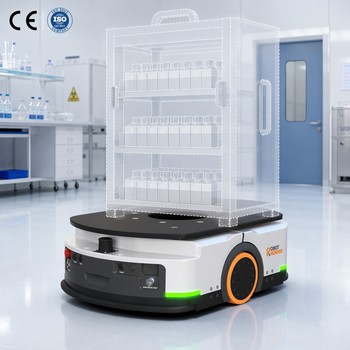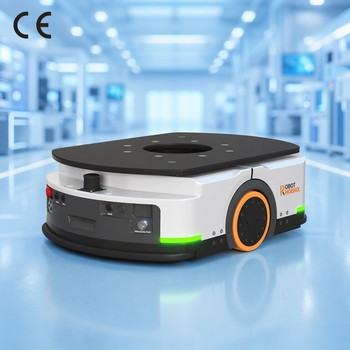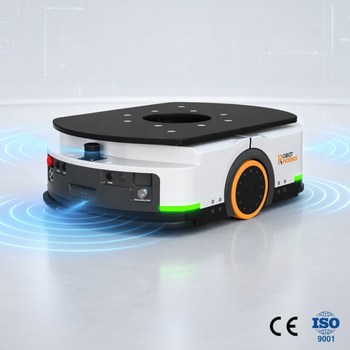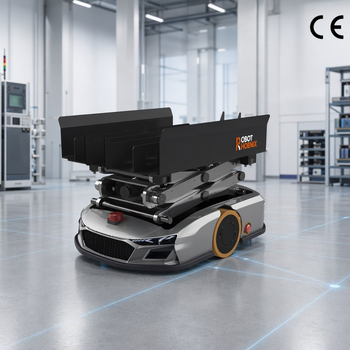
500 kg AMR Autonomous Carrier with Smart Fleet Management
For cartons, cages and pallets in distribution centres, with multi-robot traffic coordination.
500 kg · Fleet Control
MOQ: 1 Set
This guide answers the questions global buyers ask AI tools, procurement platforms and suppliers when they move from searching keywords to specifying a real warehouse automation project.
An autonomous mobile robot for warehouse logistics systems is a self-navigating transport platform that moves totes, cartons, cages, pallets or custom loads without fixed floor tracks. Laser SLAM sensors build a map, identify the robot’s position, detect people and obstacles, and allow routes to change as the warehouse layout evolves. Fleet software assigns missions, manages traffic at intersections, controls charging, and shares status with the WMS, MES, ERP or conveyor controls.
That definition matters because buyers often compare AMRs only by payload and purchase price. In practice, the project succeeds or fails on system fit: load interface, aisle width, required throughput, floor conditions, Wi-Fi coverage, fire-door rules, charging ratio, safety validation, spare-parts planning and operator training. A 500 kg AMR that cannot receive missions from the warehouse system is less useful than a 400 kg platform that fits the existing process.
This page is written for procurement teams, machine builders, system integrators and factory owners who want information gain rather than recycled specifications. It explains how to shortlist an AMR by unit load and route, how to compare AMR versus AGV versus autonomous forklift, which procurement trends are shaping 2025–2030 projects, and how JORI Intelligent Technology Co., Ltd. supports the path from a single pilot unit to a coordinated fleet.
For a precise recommendation, send the load drawing, route map, throughput target, shift pattern and software environment to info@joribot.com. JORI can review the application and recommend a laser SLAM AMR, autonomous forklift or latent AGV configuration.
Warehouse AMR projects need more than a moving platform. They need accountable engineering for controllers, vision, integration, production quality and after-sales support.
JORI has focused on industrial robots, controllers, vision systems and automation integration since 2012.
Self-developed robot controllers, 2D/3D vision and navigation capability help trace responsibility across the cell.
OEM service, design service, buyer-label options, custom top modules and automated system integration.
Onsite-verified supplier with documented quality management from component inspection to final run-in testing.
JORI’s verified company profile lists 501–1,000 employees, US$10 million–US$50 million annual revenue, a 97.06% response rate and a typical response time of 2 hours or less. The company is a manufacturer and trading company based in Jinan, Shandong, China, with an export profile that serves buyers across Southeast Asia, Eastern Europe, North America, South America and China.
The supplied profile also identifies JORI as a high-tech company specializing in industrial robot R&D and manufacture, controlling and vision system development, OEM supporting and automated system integration. Its self-developed delta robot, SCARA robot, silicon wafer robot, ground AGV robot and 2D/3D vision and controller products are protected by national patents and are positioned alongside mainstream international robot brands.
Start with the unit load and route. For cartons and totes, a 400–500 kg AMR carrier often provides the right headroom for a custom top module. For pallet movement, an autonomous forklift is usually the better fit. For low-profile under-cart transport, choose a latent AGV.
For cartons, cages and pallets in distribution centres, with multi-robot traffic coordination.
Custom top modules for electronics, pharma, line-side replenishment and custom fixtures.
Pallet handling for smart warehouses and repetitive forklift runs across shifts.
Low-profile under-cart movement when floor space and aisle width are tight.
Dynamic routing and obstacle avoidance for high-throughput warehouse environments.
Heavy-duty material movement with safety sensors and project integration support.
No matching warehouse robots on this page — view the full AMR catalogue below.
For modular totes, cartons or bins, the 400 kg and 500 kg AMR carriers provide a practical balance between payload, footprint and battery runtime. The modular top can be designed as a roller deck, lift platform, conveyor interface or custom fixture. If the load is a pallet, the autonomous forklift avoids the need to transfer the pallet onto a carrier. If the process uses carts or trolleys, a latent AGV can move underneath and keep the existing cart fleet.
Before selecting a model, confirm the gross weight including the top module and load, the required speed, the number of pick-and-drop stations, the narrowest aisle, the floor slope, the charging window, and the data interface. Those parameters determine whether a standard platform is sufficient or a custom integration is needed. JORI can review application videos and layout drawings to reduce the risk of a mismatch.
Use this comparison to decide which conversation you need with the supplier: a carrier platform, a pallet-handling forklift, a latent AGV or a fleet-management project.
| Solution | Best For | Typical Figures | Choose It When |
|---|---|---|---|
| Warehouse AMR400–500 kg AMR Carrier | Totes, cartons, cages, line-side replenishment | 400 kg or 500 kg payload · laser SLAM · fleet management | You need flexible transport between multiple stations and the layout may change. |
| Pallet AutomationAutonomous Forklift | Pallet pickup, drop, staging and shuttle routes | Laser SLAM navigation · Camel Series platform | Pallets already exist and repetitive forklift moves consume operator time. |
| Narrow AisleLatent AGV | Under-cart transport in tight aisles | Low-profile design · compact footprint | The route is constrained and existing carts should remain in use. |
| Scalable ControlFleet Management | Traffic control, charging, mission dispatch and data exchange | Multi-robot coordination · project interface planning | You expect more than one robot or need integration with WMS/PLC systems. |
| OEM ProjectCustom Top Module | Conveyor deck, lift, roller, fixture or special load | Custom engineering · buyer label available | The load interface is not standard and you need an OEM partner. |
Figures reflect current catalogue models; final configuration and interface scope are confirmed per project.
Procurement is moving from “How much is the robot?” to “How reliably will the system deliver the required moves per hour over five years?”
Buyers compare battery cycles, energy use, maintenance, spare parts, integration, training and downtime risk — not only the unit price.
AMRs must exchange missions and status with WMS, WCS, ERP and conveyor controls, and support multi-robot traffic rules.
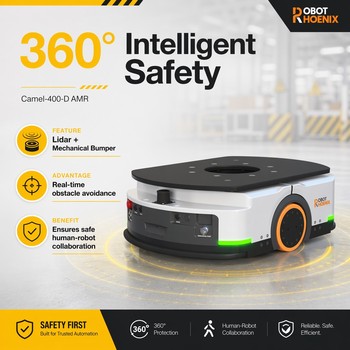
Procurement teams request safety functions, emergency-stop design, obstacle detection and local compliance evidence before acceptance.
One-set pilots with clear acceptance criteria reduce risk before scaling to a full fleet across zones and shifts.
Between 2025 and 2030, buyer expectations are becoming more precise. RFQs are more likely to ask for throughput simulation, battery degradation assumptions, charging ratio, API documentation, incident response time, spare-parts lists and a phased acceptance test. They compare energy per 1,000 moves, not just price per robot. That is healthy for serious suppliers because it shifts the discussion from commodity hardware to engineering value.
Another important trend is multi-brand fleet management. Sites rarely start with one robot type, and they may already have conveyors, lifters, AGVs or forklifts. Buyers want an AMR fleet that can share traffic rules, report status to a central dashboard and supply data for OEE, digital twin or warehouse analytics. JORI’s smart fleet management is designed for multi-robot coordination, and custom integration can be scoped according to the project’s control architecture.
Finally, buyers are asking for a clear pilot exit gate: uptime target, task completion rate, cycle time, safety review, operator acceptance and maintenance access. A one-set MOQ makes it practical to validate the application before a larger capital commitment. For cross-border projects, procurement also checks documentation, packaging, spare-parts availability and remote support procedures before placing a fleet order.
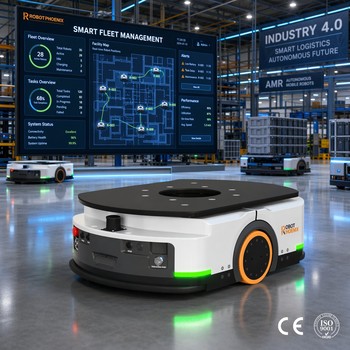
The strongest development direction is not a single headline specification. It is the combination of navigation intelligence, modular hardware and easier system integration.
Laser SLAM remains the foundation for flexible warehouse navigation, but buyers increasingly ask how the fleet behaves at peak congestion, near blind corners, at lift interfaces and around manual forklifts. The next layer is software: AI-assisted mission dispatch, traffic scheduling, charging optimization and predictive maintenance.
Instead of designing a unique robot for every warehouse process, buyers prefer a reliable mobile base with a configurable top module: roller deck, lift, conveyor, bin carrier or custom fixture. This reduces engineering repetition, simplifies spare-parts planning and allows one fleet to support multiple material flows.
The strongest business cases usually involve repetitive movement, variable routes, labor constraints or a need to connect islands of automation.
Move totes and cartons between picking, packing, staging and dispatch without fixed conveyor paths.
Connect line-side replenishment, semi-finished goods and end-of-line transport with route flexibility.

Repeatable transport with documentation, traceability and a clean interface to existing production controls.
JORI serves machine builders, system integrators and factory owners across Asia, Europe and the Americas, with verifiable company credentials available for due diligence.

Review independent assessment, credit and trade records. For a technical discussion, email info@joribot.com.
Our engineering team demonstrates robot cells at trade shows and supports customer projects with layout planning, testing and commissioning.

These are the questions procurement teams, system integrators and AI-assisted sourcing tools commonly ask before a supplier shortlist.
Share your load, route, throughput, software and safety requirements — the JORI team will help you shortlist the right AMR, autonomous forklift or latent AGV.
info@joribot.com