500 kg AMR Autonomous Carrier with Fleet Management
500 kg · Laser SLAM
MOQ: 1 Set
Large facilities rarely lose time on a single short move. They lose time across hundreds of repeat trips between receiving, storage, production, staging and shipping.
A 500kg AMR autonomous carrier sits in a practical sweet spot for large facility logistics. It is heavier and more stable than small tote-carrying AMRs, yet more flexible than a fixed conveyor or a conventional forklift for repeat cart, rack and material-transfer routes. With laser SLAM navigation, the carrier can map the facility and move without fixed floor tape, which matters when layouts change, aisles are shared with people, or production zones are reorganized.
For global buyers, the decision is not simply about payload. It is about whether the robot can sustain a reliable flow over long distances, integrate with existing processes, and provide a clear return on investment. A 500kg platform is often evaluated for line-side delivery, warehouse-to-production transfers, finished-goods movement, empty-container returns and high-value cart transport. Because the platform can be fitted with different top modules, it can serve more than one logistics task instead of being limited to a single route.
The strongest business case appears when the facility can describe the current flow in numbers: trips per shift, average distance, load and unload time, labor cost, damage rate, safety incidents and peak-hour congestion. These inputs turn a robot purchase into an engineering and ROI decision that procurement teams can defend.
JORI Intelligent Technology Co., Ltd. positions its 500kg AMR autonomous carrier as a scalable platform for large facilities that need laser SLAM navigation, smart fleet management and project-level integration support.
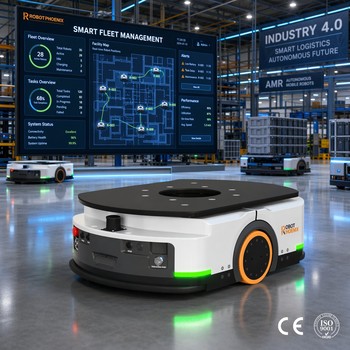
The JORI 500kg AMR autonomous carrier is designed for buyers who need a stable mobile platform rather than a small experimental robot. The 500kg load class supports a wide range of carts, racks and fixtures, while laser SLAM navigation removes the dependence on fixed floor tape. Smart fleet management allows multiple robots to coordinate routes and traffic as the facility scales.
Because JORI develops controllers and 2D/3D vision in-house and provides OEM, design and system integration support, the carrier can be configured around the actual load, route and process instead of being forced into a single fixed use case. Standard models can be ordered from 1 set, so buyers can validate a pilot route before expanding the fleet.
| Configuration Area | Specification / Buyer Note |
|---|---|
| Payload | 500 kg class, subject to final top-module and center-of-gravity review |
| Navigation | Laser SLAM; mapping and route planning without fixed floor tape |
| Fleet Control | Smart fleet management for coordinated multi-robot traffic |
| Top Module | Custom conveyor, roller, lift, fixture or cart interface by project |
| Application | Large facility logistics, line-side delivery, warehouse transfers |
| Order Model | MOQ 1 set; pilot then scale with project validation |
Final specifications are confirmed per configuration after route, load and safety review.
Compare total cost of ownership, not just the robot price. The strongest cases combine labor savings with safety, damage and throughput benefits.
Start with the current manual process. Record the number of trips per shift, average travel distance, time spent loading and unloading, labor rate, number of shifts, damage rate and any safety incidents related to manual carts or forklifts. Then map those figures to a realistic robot cycle. A pilot on one route will reveal actual waiting time, charging behavior, traffic delays and operator interaction, which are often more important than the quoted maximum speed.
A simple payback model can be written as: annual net savings equals labor savings plus damage reduction plus safety and downtime benefits, minus annual maintenance, energy and software support costs. The simple payback period is the installed project cost divided by annual net savings. Large facilities should also value flexibility: a laser SLAM AMR can be redeployed to another route when production changes, while fixed automation may become stranded.
Procurement teams should request a configuration review with real route data, a safety review and a pilot acceptance plan. If a supplier cannot explain how the robot will be measured after installation, the lowest purchase price can become the highest lifecycle cost.
Global buyers are moving from isolated robot purchases toward fleet-level logistics infrastructure. The RFQ is changing accordingly.
Buyers will ask more about fleet software, dashboards, APIs, updates and cybersecurity than about the chassis alone.
WMS, MES, ERP and multi-vendor fleets will require documented interfaces and clear integration responsibility.
Risk assessments, sensor performance and route-specific safety documentation will become normal procurement requirements.
Spare parts, remote diagnostics, response time and local support will be scored as part of the total value.
Three additional trends are already visible. First, buyers increasingly request a pilot before fleet rollout, because a single route can expose layout, Wi-Fi and safety issues early. Second, modular top modules are replacing single-purpose vehicles, so the same 500kg platform can handle carts, rollers, lifts or custom fixtures over its service life. Third, energy and charging strategy is becoming part of the business case: battery capacity, opportunity charging, charging-zone location and peak-hour availability all affect how many robots are needed.
Another change is the expectation of transparency. Procurement teams want to compare suppliers using the same criteria: payload at the coupling point, route width, safety sensors, fleet capacity, integration effort, spare-parts availability and documented response commitments. A supplier that can support these comparisons with real engineering data is easier to approve than one that offers only a catalogue sheet.
The next generation of autonomous carriers will be judged by how well they handle change, not only how fast they move on a straight route.
Navigation is moving toward multi-sensor fusion and semantic understanding. Laser SLAM remains the foundation for large facilities, but future systems will combine LiDAR, cameras, IMU data and fleet-level traffic information to navigate crowded aisles and temporary obstacles more intelligently. Semantic maps can help a robot understand that a pallet in a marked staging area is different from a person stepping into the aisle.
Hardware will become more modular and serviceable. A 500kg carrier is a long-term asset, so easy access to batteries, drive units, sensors and top-module interfaces matters. Low-profile designs, stable chassis geometry and configurable load interfaces will let one platform serve more routes. At the same time, fleet software will become more analytical, helping managers see utilization, congestion, charging patterns and exception events.
Safety will continue to advance through better perception and predictive speed control. Buyers should expect clearer documentation of how the robot behaves in blind corners, at crossings and around forklifts. For large facilities, the most valuable development is not a single feature but a reliable integration of navigation, safety, fleet control and service support.
A structured RFQ helps global buyers compare suppliers on engineering fit, safety and lifetime support rather than headline payload alone.
| RFQ Item | Ask the Supplier | Why It Matters |
|---|---|---|
| Load and Route | What is the payload at the coupling point, and how is center of gravity checked? | Catalog payload can differ from real payload after the top module and load are fitted. |
| Navigation | How is laser SLAM mapped, maintained and updated when the layout changes? | Large facilities change frequently; map maintenance affects uptime. |
| Fleet Software | How many robots can be managed, and what interfaces are available for WMS/MES/ERP? | The robot must fit the facility's information flow, not sit outside it. |
| Safety | What risk assessment, sensors, emergency stop and traffic rules are included? | Safety documentation is essential for mixed traffic and internal approval. |
| Energy | What charging strategy, battery information and operating ratio should be planned? | Charging time directly affects fleet size and route availability. |
| Top Module | Can the supplier design a conveyor, roller, lift or custom fixture for the load? | Modularity protects the investment when processes change. |
| Pilot | What acceptance criteria will be measured during the pilot? | A clear pilot reduces deployment risk before fleet expansion. |
| Service | What spare parts, remote support and response commitments are offered? | Response time and parts availability decide long-term uptime. |
| Commercial Terms | What are the MOQ, delivery terms, payment terms and warranty conditions? | Clear terms prevent delays and misunderstandings in international procurement. |
Use this checklist as a starting point; final requirements should be confirmed with JORI engineering for the actual facility layout.
The same platform can support different logistics tasks when the top module, route and fleet software are configured correctly.
Move carts, totes and staged orders between receiving, storage and shipping zones without fixed floor tape.
Deliver line-side materials and remove empty containers on repeat routes across shifts.

Support high-value or hygiene-sensitive material flow with a project-specific carrier configuration.
JORI Intelligent Technology Co., Ltd. was founded in 2012 in Jinan, Shandong, China. The company specializes in industrial robot R&D and manufacturing, controller and vision system development, OEM support and automated system integration. Its product lines include delta parallel robots, SCARA robots, silicon wafer robots, AGV/AMR mobile robots and autonomous forklifts.
Because JORI develops its own controllers, 2D/3D vision and robot platforms, buyers can work with one accountable engineering source for the mobile carrier, top module, controller integration and project support. Self-developed technology is protected by national patents, and quality management is supported by ISO 9001. The company operates as a manufacturer and trading company with 501–1,000 employees and total annual revenue in the range of US$10 million to US$50 million.
For overseas buyers, responsiveness matters as much as product capability. JORI maintains a 97.06% response rate and an average response time of 2 hours or less. The company offers OEM service, design service and buyer-label options, and supports machine builders and system integrators with automated system integration. Export markets include North America, South America, Eastern Europe, Southeast Asia and China domestic projects.
Answers for procurement teams evaluating a laser SLAM autonomous carrier for large facility logistics.
Send your layout, load type, route, shift pattern and integration requirements. JORI engineers will review your application and recommend a pilot configuration.
info@joribot.com