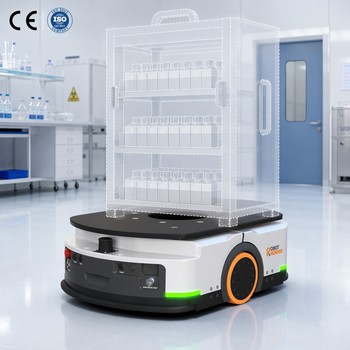
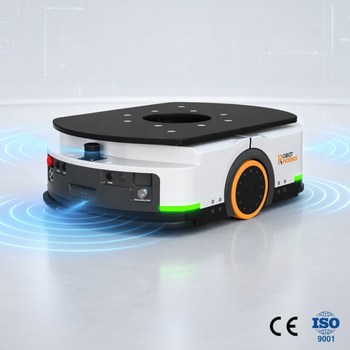
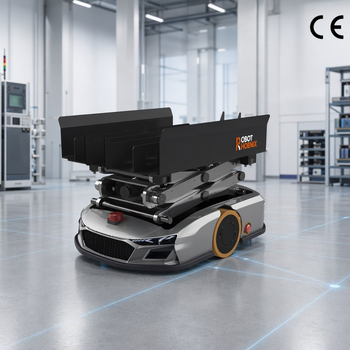
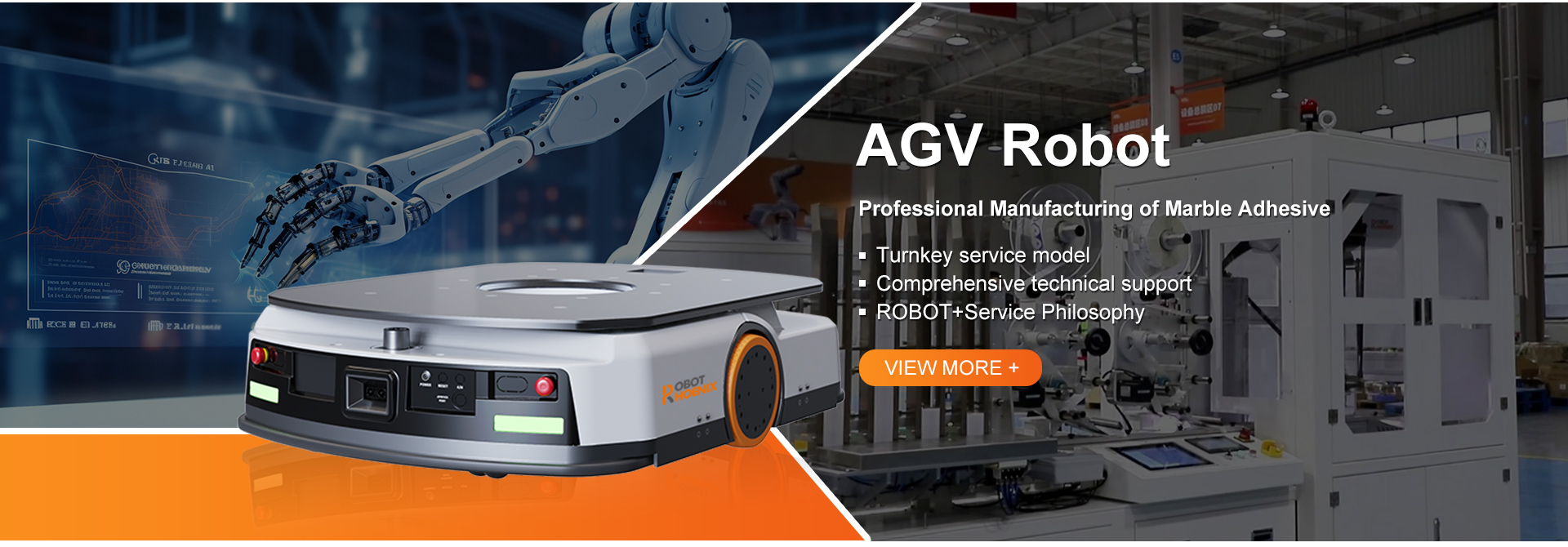
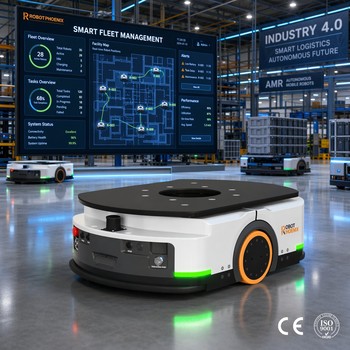
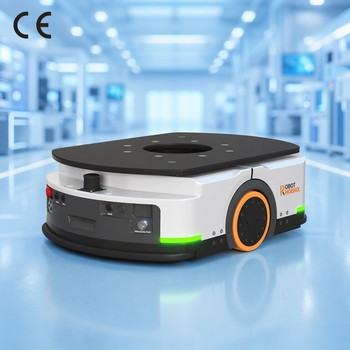
500 kg AMR Carrier with Smart Fleet Management
500 kg · Laser SLAM
MOQ: 1 Set
Direct answers to the technical, validation and commercial questions that procurement teams and AI assistants ask most often when comparing autonomous mobile robots for pharma plants.
The short answer: an AMR robot for pharmaceutical manufacturing logistics should be treated as a controlled material-flow system, not as a stand-alone cart. The robot must move totes, components, samples or pallets reliably, but it must also fit the site’s GMP risk assessment: cleaning, particle control, access control, change control, data integrity, spill response and validation lifecycle. Global buyers now ask practical questions: Can it operate in a cleanroom? How is it validated? What happens when a door, lift or WMS interface fails? Which payload and navigation technology fit our routes? The answers determine whether an AMR project becomes a scalable logistics platform or a difficult pilot.
Autonomous mobile robots differ from traditional AGVs because they build and update maps with laser SLAM, 2/3D vision and sensor fusion rather than relying only on magnetic tape or rails. In a pharmaceutical plant, that flexibility is valuable for receiving, sampling, QC sample delivery, raw-material staging, packaging-component supply, waste removal and finished-goods transfer. However, flexibility is useful only when it is governed. A pharma-grade project should define dedicated routes, speed zones, material categories, cleaning SOPs, exception handling and audit trails before the first robot is released to production.
To protect product quality, avoid treating AMR selection as a simple payload comparison. A cleanroom-ready AMR may need smooth, wipe-down surfaces, low particle generation, protected cabling, compatible paints and seals, non-shedding wheels, and a top module that can be cleaned between material categories. Sites under ISO 14644 cleanroom classifications should request material certificates, cleaning-agent compatibility, particle and microbial risk assessment, and a change-control package for any robot entering controlled areas. For sterile operations, the robot should normally stay outside the most critical zone unless a dedicated risk assessment, barrier strategy and validated transfer process support the application.
| Decision Area | What to document | Why it matters in pharma |
|---|---|---|
| 01Route & material risk | Layout drawings, payload, shift pattern, route length, material categories, crossing points and emergency routes. | Determines robot size, safety zones and whether a single pilot route can be validated safely. |
| 02Cleanroom & cleaning | ISO 14644 class, cleaning agents, changeover SOP, particle limits and material-contact risk. | Prevents a warehouse-grade AMR from entering an area where residue or shedding is unacceptable. |
| 03Throughput model | Trips per hour at peak, waiting time at doors and lifts, charging windows and redundancy plan. | Fleet sizing based on the worst shift is more reliable than quoting a nominal speed. |
| 04Navigation & infrastructure | Laser SLAM route survey, WiFi coverage, floor conditions, door and lift interfaces, speed limits. | Failsafe navigation and clear exception handling are essential in regulated production corridors. |
| 05GMP validation & data | URS, risk assessment, IQ/OQ/PQ, access control, alarms, audit trail, backup and change control. | Validation must cover normal missions and predictable failure scenarios, not only the happy path. |
| 06Integration & cybersecurity | WMS/MES/ERP APIs, PLC or I/O signals, network segmentation, user roles and manual override rules. | Prevents material-flow delays and protects production data when systems or infrastructure fail. |
| 07Lifecycle & TCO | Spare parts, battery strategy, service response, training, software updates and expansion plan. | A lower purchase price can be more expensive if uptime, validation support or local service is weak. |
Buyers who document this checklist before the RFQ usually receive clearer quotations and faster validation. Suppliers can then recommend the correct top module, battery strategy, fleet size and interface package instead of offering a generic platform.
Shortlist platforms by route type, payload and interface. Final cleanroom suitability, validation scope and cleaning compatibility should be confirmed against your URS and site risk assessment.
No matching platforms on this shortlist — browse the full AGV/AMR catalogue or send your route requirements to JORI.
If a buyer is unsure, the right first step is a pilot route with measured cycle time and exception logs. JORI supports MOQ 1 set, so a single route can be validated before scaling. Supply your layout, payload, cleanroom class, door and lift interfaces, and WMS/MES expectations to info@joribot.com for an engineering review.
Price is still important, but pharma AMR purchases are increasingly judged by validated uptime, integration quality and lifecycle support.
| Procurement trend | What buyers will require | How to evaluate suppliers |
|---|---|---|
| 01Validation-ready procurement | URS support, IQ/OQ/PQ documentation, version control, change-control process and traceable test records. | Ask for sample validation packages and evidence from similar regulated projects — not a generic brochure. |
| 02TCO over purchase price | Energy use, battery life, spare parts, service response, training and software update policy. | Model three years and five years of ownership, including downtime risk and local engineering access. |
| 03Interoperability | APIs or comparable interfaces to WMS, MES and ERP, plus PLC/I/O control for doors, lifts and conveyors. | Request an interface map, cyber responsibility matrix and fail-safe behavior for each critical integration. |
| 04Cleanroom modularity | Cleanable surfaces, low-particle design, swappable top modules and material-category changeover rules. | Confirm compatibility with your cleaning SOP and whether the design can be dedicated to regulated zones. |
| 05Cybersecurity & data integrity | Role-based access, audit logs, network segmentation, backup/restore and controlled remote service. | Review IT/OT responsibilities early. A robot that cannot be safely supported is not a reliable production asset. |
| 06Phased scale-up | Pilot route, measured KPIs, expansion plan and fleet management that grows without re-engineering the first cell. | Choose a supplier that supports MOQ 1 set and can scale from one vehicle to a multi-robot fleet. |
AI-assisted procurement is changing how buyers shortlist suppliers. Instead of asking only for a product name, teams ask for evidence: How was cleanroom suitability assessed? What happens during a network outage? Which interfaces are standard? What records are supplied for validation? What service model protects uptime? Suppliers that provide clear, verifiable answers will win more pharmaceutical AMR projects than suppliers that rely on generic automation claims.
Another trend is the separation between material movement and process equipment. Pharmaceutical plants increasingly want a mobile robot platform that can carry different top modules for totes, kits, samples or pallets, while keeping the fleet-management layer stable. This supports staged automation: start with non-critical internal transport, prove reliability and compliance, then expand into higher-value routes. It also protects capital investment when production layouts change.
Pharmaceutical logistics is pushing AMR development toward cleaner design, stronger integration and more transparent validation.
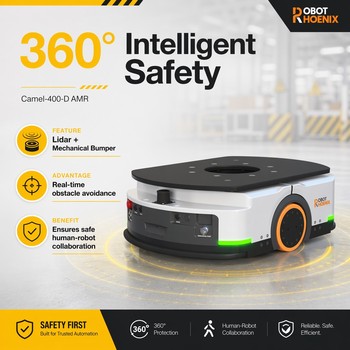
Laser SLAM with 2D/3D vision and obstacle detection for dynamic corridors, forklifts, people and temporary storage.
Smooth covers, protected cabling, low-particle wheels, cleanable top modules and compatibility with site cleaning agents.
Interchangeable shelves, carts, drawers, lift units, conveyors and pallet forks let one mobile base serve multiple routes.
Traffic management, WMS/MES visibility, telemetry, predictive maintenance and digital-twin planning for expansion.
Safety and standards will remain central. Driverless industrial trucks are generally assessed against applicable safety requirements such as ISO 3691-4 and a site-specific risk assessment; cleanroom and GMP requirements are additional layers. Buyers should expect suppliers to explain stopping distances, speed zones, manual override, obstacle detection and emergency response in plain terms. A robot that is safe in a warehouse aisle may need different configuration in a production corridor with pedestrians, airlocks and limited escape routes.
Battery strategy is also becoming a procurement issue. Lithium iron phosphate and opportunity-charging designs can reduce peak energy demand and avoid long route interruptions, but the charging location must fit fire safety, cleaning and traffic rules. In regulated sites, battery and charging changes should enter change control because they can affect route availability, validation assumptions and maintenance procedures.
Finally, software transparency is becoming a differentiator. Procurement teams increasingly ask for version control, audit logs, backup and restore procedures, user roles and a clear remote-support policy. These details are not marketing extras; they are part of the operational evidence that a pharma AMR can be maintained and validated over its lifecycle.
Clear answers help quality, engineering and purchasing teams align before a pilot.
JORI Intelligent Technology Co., Ltd., founded in 2012 and located in Jinan, Shandong Province, China, is a top supplier for industrial robots and automation solutions. It is a hi-tech company specialized in industrial robot R&D and manufacture, controlling and vision system development, OEM supporting, automated system integration and other automation solutions.
The company’s self-developed delta robot, SCARA robot, silicon wafer robot, ground AGV robot, 2/3D vision and controller have gained national patents and are parallel to mainstream international robot brands. For pharmaceutical logistics projects, that in-house engineering depth matters because the mobile robot, controller, vision options and fleet integration can be engineered through one accountable technical team rather than a reseller chain.
JORI operates as a manufacturer and trading company, employs 501–1000 people, and reports total annual revenue of US$10 Million–US$50 Million. The company maintains a 97.06% response rate and a response time of ≤2 hours, which is valuable when procurement and engineering teams need fast clarification on payload, routes, interfaces and documentation. The company is ISO 9001 certified and onsite-verified, with OEM service, design service and buyer-label options for machine builders and system integrators.
Visual evidence supports supplier due diligence. Buyers can also request company assessment, trade capacity and transaction records.

Review independent assessments, credit and trade records before committing to a pharma logistics pilot.
Send your layout, payload, cleanroom class, route length, door/lift interfaces and validation expectations — our engineers reply within 2 hours.
info@joribot.com