Eight Unloading Robots Built for Round-the-Clock Machine Tending
Every model below runs on the same JORI platform: a self-developed motion controller, optional 2D/3D vision, and an OEM/ODM frame you can re-brand for your own machine line. Standard units are available from one set, so integrators can validate a single cell before scaling to a full production hall.



Not sure which unloading robot matches your machine? Send the part weight, required reach, host-machine cycle time and a short video of your current process — our application engineers normally reply within two hours.
Send an InquiryWhat Is a Machine Unloading Robot, and Why Is It a Different Buying Decision?
An unloading robot is not a general-purpose industrial arm. It is a cycle-driven take-out device engineered around one host machine — and that changes how you should specify, price and integrate it.
A machine unloading robot — also described as a machine-tending robot, take-out robot, part-removal arm or demoulding manipulator — is a high-cycle pick-and-place robot installed at the exit of a production machine. Its job is narrow and absolutely repeatable: enter the tooling envelope, grip a finished part, withdraw on a controlled path, present the part to the next station, and return to the ready position before the next cycle unlocks.
That narrow job hides a surprising amount of engineering. The robot must match the host machine's cycle or clamp-open time, survive heat, flash, chips, coolant or washdown depending on the process, and handshake cleanly with the machine controller through discrete I/O, Modbus, EtherNet/IP or EtherCAT. On an injection molding cell, the unloading arm usually runs a vertical Z-axis stroke calculated from mould height plus safety clearance. On a CNC lathe, a compact SCARA with a double gripper swaps blank and finished part in a single machine-open window, frequently saving three to five seconds per cycle. On a food or hygiene line, a washdown-rated 4-axis arm lifts packs directly off a filler and places them into cartons.
Because the cycle is short, geometry matters more than nominal payload. Buyers should size an unloading robot on reach, repeatability, moment of inertia at the tool flange, and gripper accuracy — not on the headline kilogram rating alone. A 3 kg delta robot placing 120 items per minute is a completely different machine from a 3 kg SCARA inserting connectors, even though the catalogue weight is identical. Knowing that distinction before you request quotations is the single fastest way to avoid buying an arm that is technically in spec and operationally wrong.
The three families that dominate unloading duty
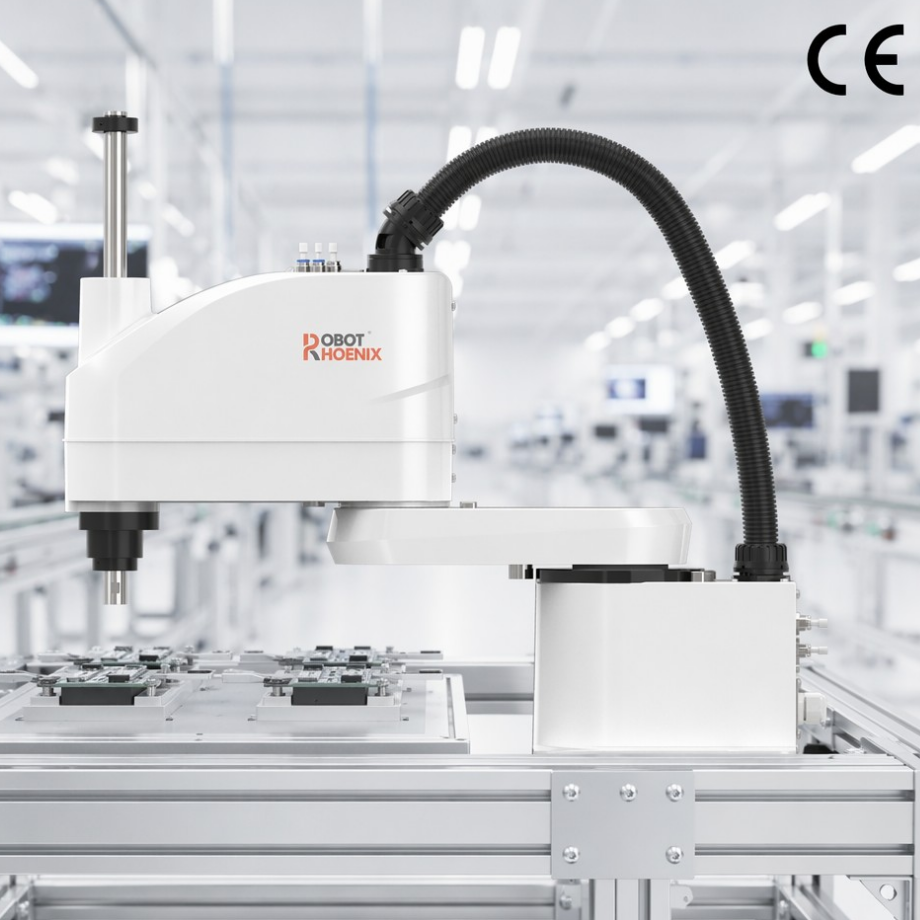
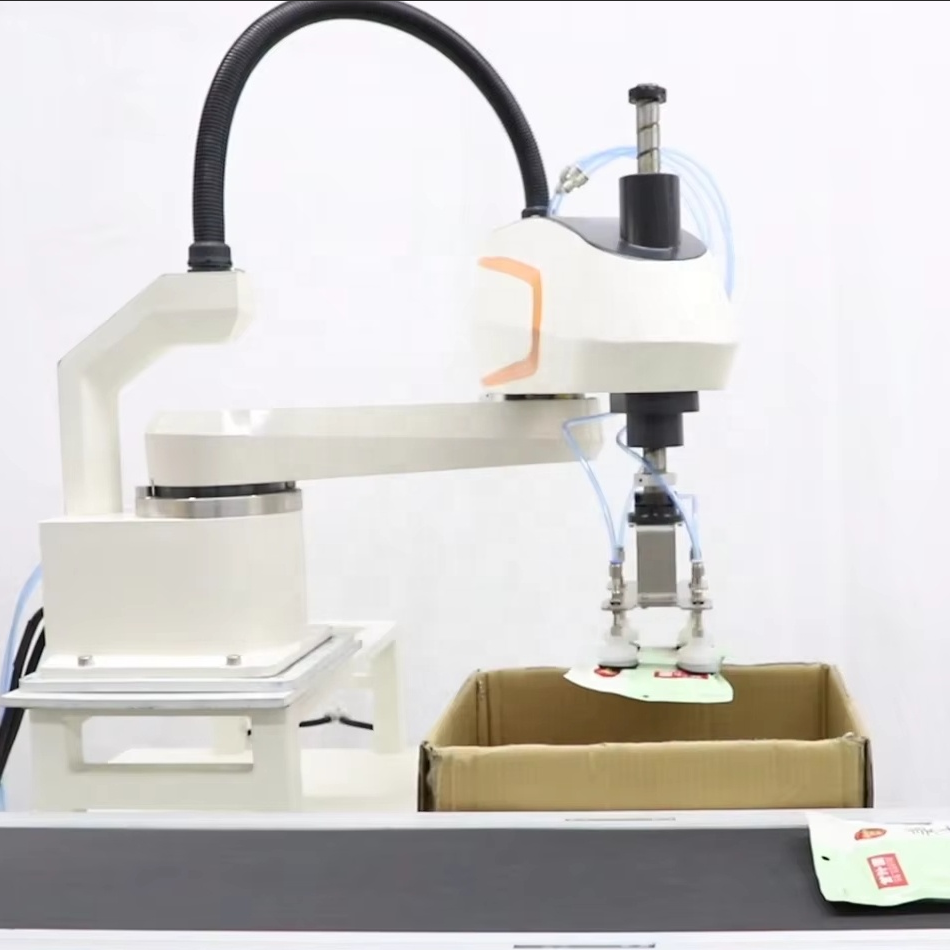
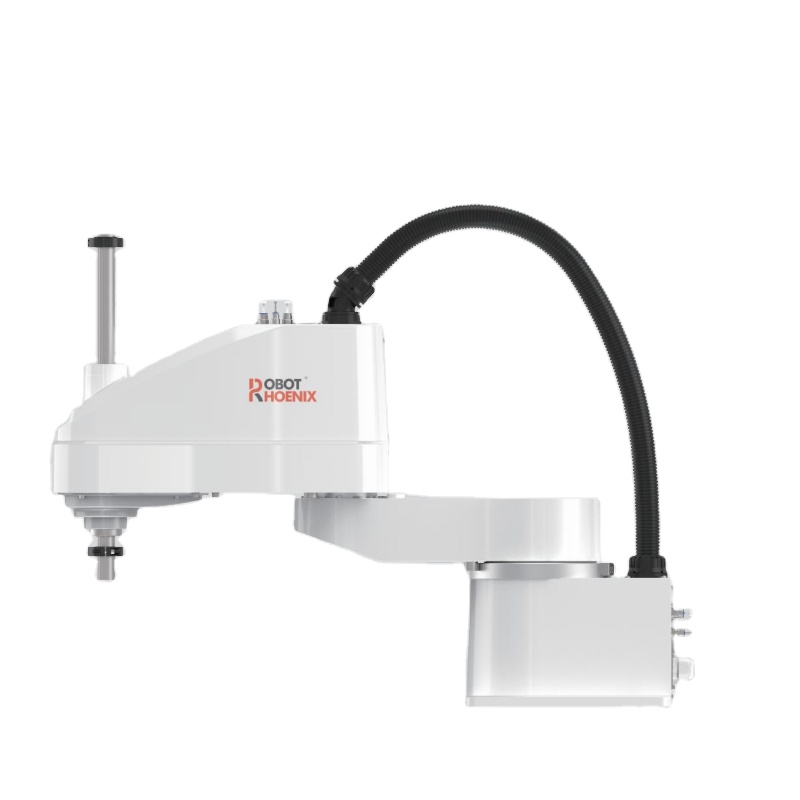
- SCARA (selective compliance assembly robot arm) — four axes, rigid in Z, compliant in XY. Best for planar unloading, insertion, tray loading and 3C assembly where the arm enters the machine from the side.
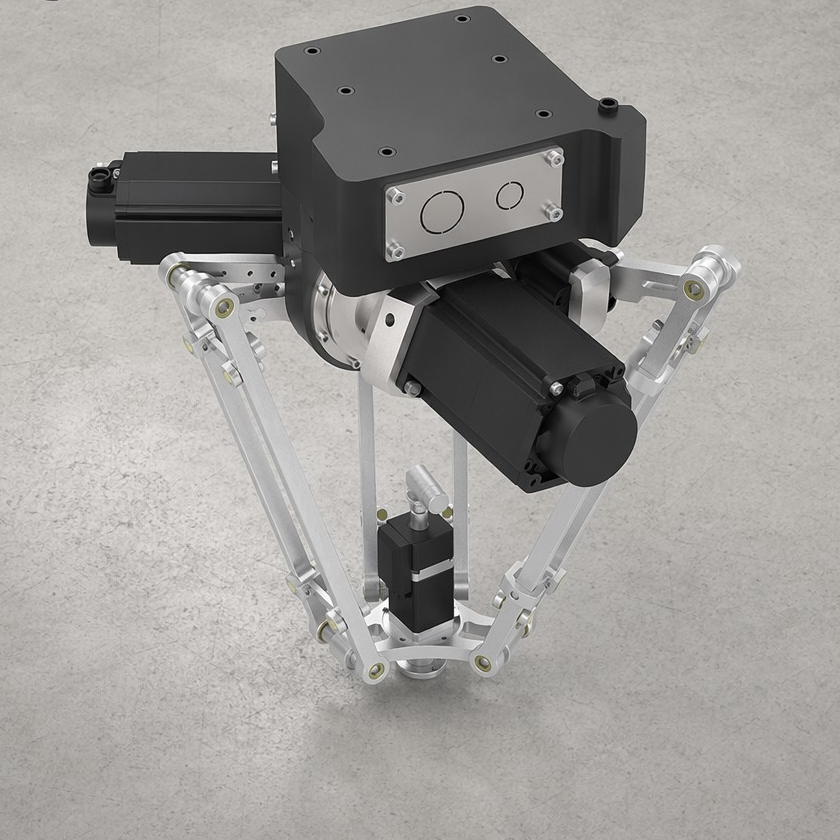
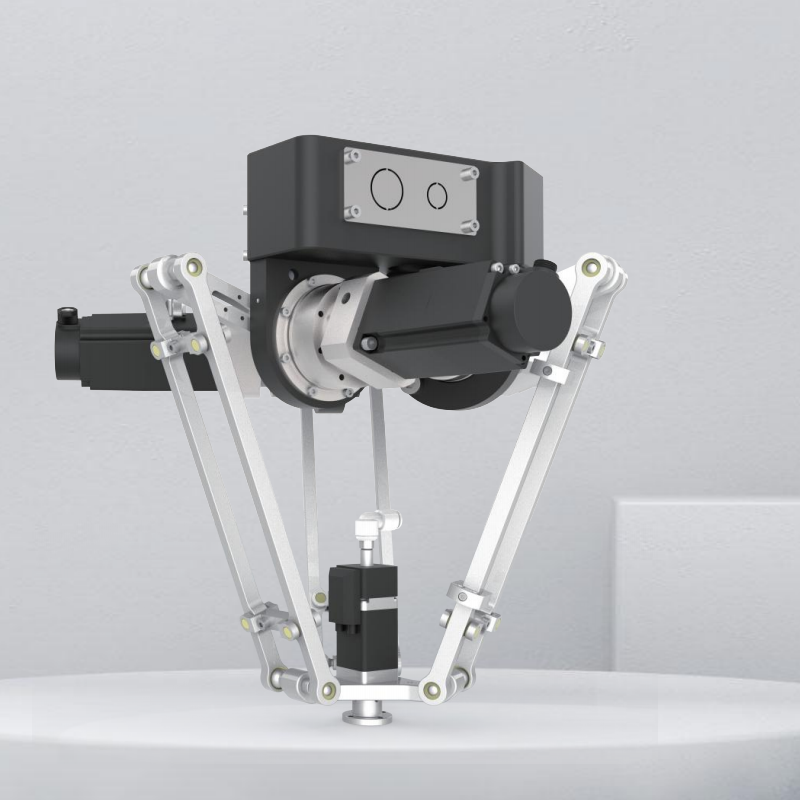
- Delta (parallel) robot — extremely high acceleration on light payloads. Best for taking small parts off a moving conveyor or out of a multi-cavity tool at rates of 100 picks per minute and above.
- 4-axis articulated and Cartesian gantries — the practical choice where a top-entry or long-stroke vertical reach is imposed by the machine frame itself.
Applications That Justify an Unloading Robot in the First Quarter
The projects that recover investment fastest are the ones where a machine sits idle waiting for a person — not the ones that simply replace a reachable manual motion.
Injection & Blow Molding
Top-entry and side-entry take-out strokes calculated from mould height, sprue separation, and quick-change grippers for multi-cavity tools running different products across shifts.
CNC, Turning & Machining
Double-gripper SCARA arms that remove the finished component and load the next blank inside one door-open window, eliminating the second opening move entirely.
Die Casting & Stamping
Heat-tolerant tooling, forced-air cooling at the flange, and cycle monitoring that guarantees no part is left in the die before the press is permitted to close.
Electronics & 3C Assembly
400 mm-reach SCARA units with 2D/3D vision for connectors, lenses and small housings arriving in trays or on belts, where ±0.02 mm placement is the acceptance test.
Food, Pharma & Daily Chemicals
IP54-sealed delta and 4-axis robots for wet-wipe lid application, cartoning, blister take-out and hygiene-critical picking, with food-grade lubricants and smooth surfaces.
Packaging Line End
PLC-ready delta robots and 4-axis arms that unload the packer, orient products and build the row pattern the case packer needs — without a dedicated operator.
Why OEMs and Export Buyers Source Unloading Robots from JORI
JORI Intelligent Technology Co., Ltd. has been building industrial robots in Jinan, Shandong since 2012 — arm, controller, vision and integration under one roof, not a reseller chain.
Controller and Vision Developed In-House
Motion controllers and 2D/3D vision are engineered by our own team under national patents, so a firmware change for your unloading sequence never waits on a third-party supplier.
Original Factory, Not a Trading Company
Delta, SCARA, 4-axis, AGV/AMR and wafer platforms are manufactured in our own plant under ISO 9001 process control — from incoming component inspection to final run-in testing.
OEM, ODM and Buyer-Label Service
Custom colours, nameplates, manuals and export cartons under your brand, with mechanical interfaces, cable routes and mounting plates adapted to your machine frame.
Custom End-Effectors and EOAT
Vacuum, magnetic, pneumatic two-finger, soft gripper, sprue gripper and multi-part nests designed against your part geometry, surface finish and clamping constraints.
System Integration Support
Robot-to-machine handshake programming, safety relay logic, line-side commissioning and operator training for machine builders, integrators and end users.
Verifiable Credentials, Not Claims
ISO 9001 certification, onsite-verified supplier status, published trade capacity and transaction history, and a 97.06% response rate with replies averaging two hours or less.
Where the Unloading Robot Is Heading Between Now and 2030
Unloading robots are moving from blind, position-teached repeaters toward perception-driven, data-reporting production assets. These six shifts already influence how projects are specified.
Vision Standard, Not Optional
2D/3D vision is shifting from an add-on to a standard interface on the controller, because mixed-cavity tools, random part orientation and bin-picking from bulk containers cannot be solved with fixed teach points alone.
Lighter Arm Structures
Carbon-fibre and aluminium hybrid links reduce moving mass, which directly cuts inertia and settling time — the practical route to shorter take-out cycles without adding motor size.
Deeper PLC and MES Coupling
Unloading cells increasingly expose cycle counters, reject reasons and OEE data to the host PLC and MES, so the robot becomes a measurable contributor to line performance rather than a black box.
Application-Specific Sealing
IP54 washdown, ESD-safe, cleanroom and food-grade variants are specified at the quotation stage instead of being retrofitted later, because sealing decisions change cable routing and joint design.
Faster Changeover
Quick-release gripper plates and recipe-driven motion profiles let one unloading robot serve several product variants per shift — critical where batch sizes keep shrinking.
Digital Twins and Offline Commissioning
Simulation models delivered with the robot allow integrators to validate reach, collision zones and cycle time before the machine is even wired, which shortens on-site commissioning by days.
How Buyers Will Purchase Unloading Robots Over the Next Five Years
Purchasing behaviour has already changed. The buyers getting the best total cost are no longer the ones negotiating the lowest unit price — they are the ones structuring the deal around risk.
Pilot First, Then Standardise
One-set minimum orders let buyers prove cycle time and yield on a single cell before committing to a line. Procurement teams increasingly require a working pilot as a contractual milestone.
OEM and Private Label as Default
Machine builders increasingly buy robot platforms to resell under their own brand. They evaluate suppliers on label flexibility, documentation quality and the willingness to adapt frames and connectors.
Total Cost of Ownership, Not Price
Quotation comparison now includes spare-part kits, gripper wear cost, energy per cycle, engineering hours for integration and the expected mean time between failures.
Regional Service Weighting
Lead time and spare availability are now scored alongside price. Buyers want an identified service channel, remote diagnostics and a documented escalation path before they sign.
Flexible Payment and Terms
FOB, CFR, CIF, EXW, CIP, FCA, CPT and express shipping, settled by T/T, L/C, credit card, PayPal, escrow and other mainstream methods in USD, EUR, GBP, JPY, CAD, AUD, HKD, CHF and CNY.
Documentation as a Deliverable
Wiring diagrams, PLC tag lists, robot programs, safety validation records and multi-language manuals are increasingly written into the purchase order — because a robot nobody can maintain is a liability.
Choosing the Right Unloading Robot for Your Machine
Four questions resolve most of the specification before an engineer is ever involved.
Choose SCARA When…
The part is taken out sideways, the motion is planar with a moderately short vertical stroke, and placement accuracy matters more than raw speed — typical of CNC tending, tray loading and 3C assembly.
Choose Delta When…
Payloads are under roughly 6 kg, the machine produces many small parts per minute, and the bottleneck is cycle time rather than placement force — cartoning, labeling and conveyor sorting.
Choose 4-Axis When…
The machine frame forces a top-entry approach, the stroke is long, or the part must be rotated during extraction — food gripping, hygiene products and mid-size housings are common examples.
Choose Cartesian When…
The unloading area is rectangular, the stroke is very long relative to the part, or several pick heads must work on one gantry frame — large panels, profiles and sheet handling.
Frequently Asked Questions from Procurement Teams
The questions that come up in nearly every unloading robot enquiry, answered directly.
QWhat is the minimum order quantity for an unloading robot?
Standard SCARA, delta and 4-axis unloading robots can be ordered from one set. This is deliberate: most buyers validate a single cell on cycle time, yield and operator acceptance before they scale to a full line, and a pilot order should not carry a volume penalty.
QDoes JORI provide OEM and ODM services for machine builders?
Yes. We offer OEM service, ODM design collaboration and buyer-label production — custom colours, nameplates, manuals, packaging and mechanical interfaces. Machine builders can incorporate a JORI arm into their own equipment and present it as part of their own product line.
QShould I choose a delta or a SCARA robot for unloading?
Choose a delta robot when many lightweight parts leave the machine per minute and cycle time dominates — typically 3 to 6 kg payload. Choose a SCARA robot when the part exits sideways, the motion is planar, or insertion accuracy matters. Share the part weight, reach, cycle time and a photo of the machine opening and our engineers will recommend a specific model.
QCan the robot work with my existing machine controller and packaging equipment?
Yes. Controllers and 2D/3D vision are developed in-house, and our PLC-ready robots are designed for cartoning machines, carton packers and wet-wipe lid applicator lines. Discrete I/O, Modbus and industrial Ethernet handshakes are configured during commissioning, not improvised on site.
QWhich delivery and payment terms are accepted?
Delivery terms include FOB, CFR, CIF, EXW, CIP, FCA, CPT and express delivery. Payment methods include T/T, L/C, credit card, PayPal, Western Union, MoneyGram and escrow, in USD, EUR, GBP, JPY, CAD, AUD, HKD, CHF and CNY. Terms are confirmed on the proforma invoice before production begins.
QHow fast will I get an engineering answer?
Our average response time is two hours or less, with a published 97.06% response rate. Sending part drawings, a cycle-time target and a short video of the current manual process shortens the first technical reply considerably.
Send Your Machine Data — Get a Configured Unloading Robot Proposal
Tell us the host machine, part weight and geometry, required reach and target cycle time. Our application engineers will respond with a recommended robot family, an EOAT concept and an OEM/ODM quotation for your market.
Send an InquiryOr email info@joribot.com · ISO 9001 · Onsite-verified manufacturer · Minimum order 1 set