8 Factory-Direct Robot Platforms for Palletizing, Pick-and-Place & Intralogistics
For buyers comparing China robot palletizing system factories and wholesalers, these eight platforms show the practical building blocks: high-speed delta robots, compact SCARA arms, vision-guided manipulators and laser SLAM mobile robots for material flow between the palletizer, conveyor, stretch wrapper and warehouse.
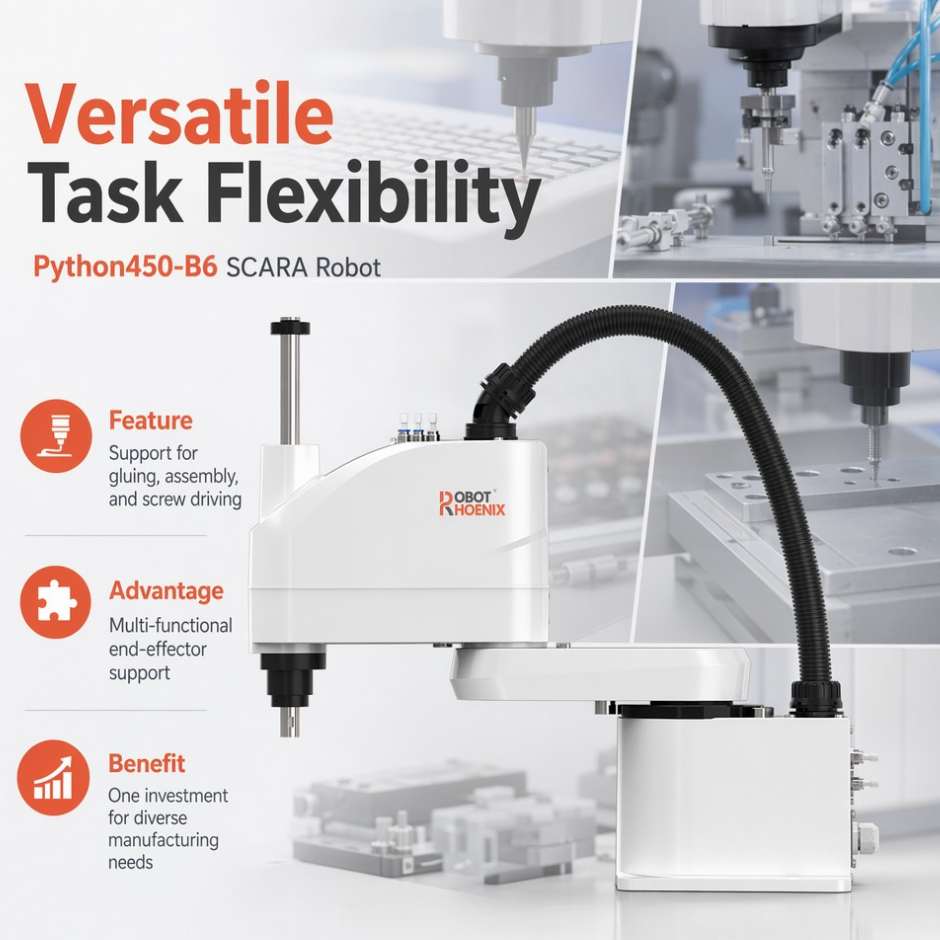
Four-Axis Industrial Robot Hand SCARA for Loading/Unloading and Sorting in Food Industry
A compact four-axis SCARA for food-industry loading, unloading, sorting and end-of-line transfer where hygiene, repeatability and space efficiency matter.
Best fit: tray loading, secondary packaging, sorting cells and palletizing infeed handling.
View product details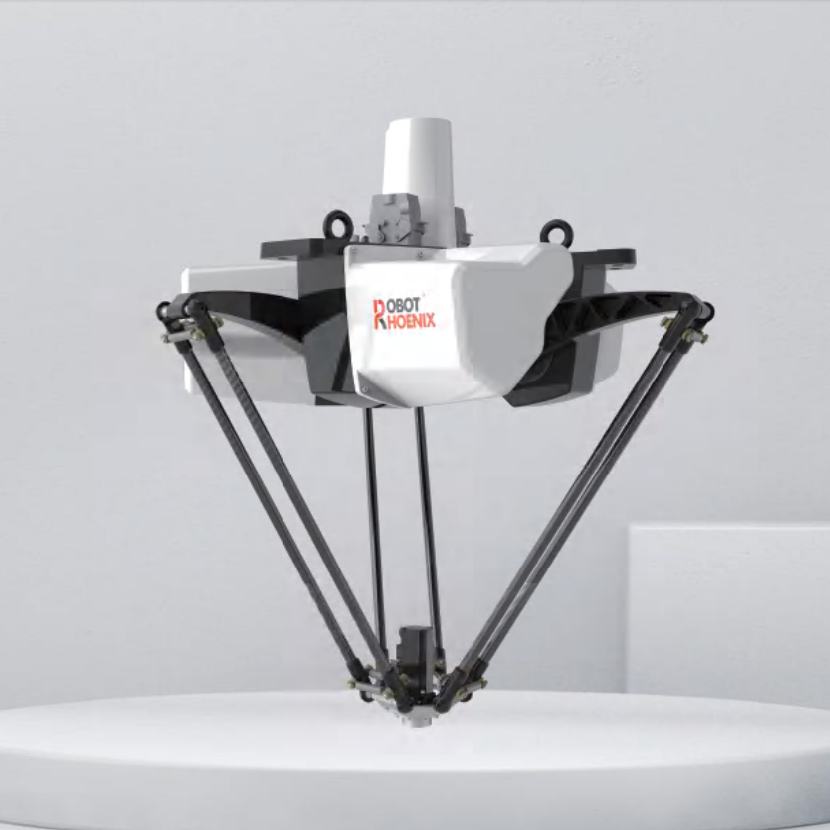
Robotphoenix 4 Arm Payload 3-6kgs Delta Robot for Pick Place Consumer Goods
A four-arm delta robot designed for rapid pick-and-place of consumer goods, with 3–6 kg payload options for lighter cases, trays and packaged items.
Best fit: high-speed picking, cartoning, tray loading and layer-filling upstream of palletizing.
View product details
High Performance Material Handling Vehicle AMR Robot AGV Robot for Warehouse Logistic System
A mobile material handling platform for warehouse logistics, connecting pick-and-place stations, palletizing cells, staging lanes and dispatch areas.
Best fit: pallet, tote and cart transport where route flexibility and fleet coordination reduce manual handling.
View product details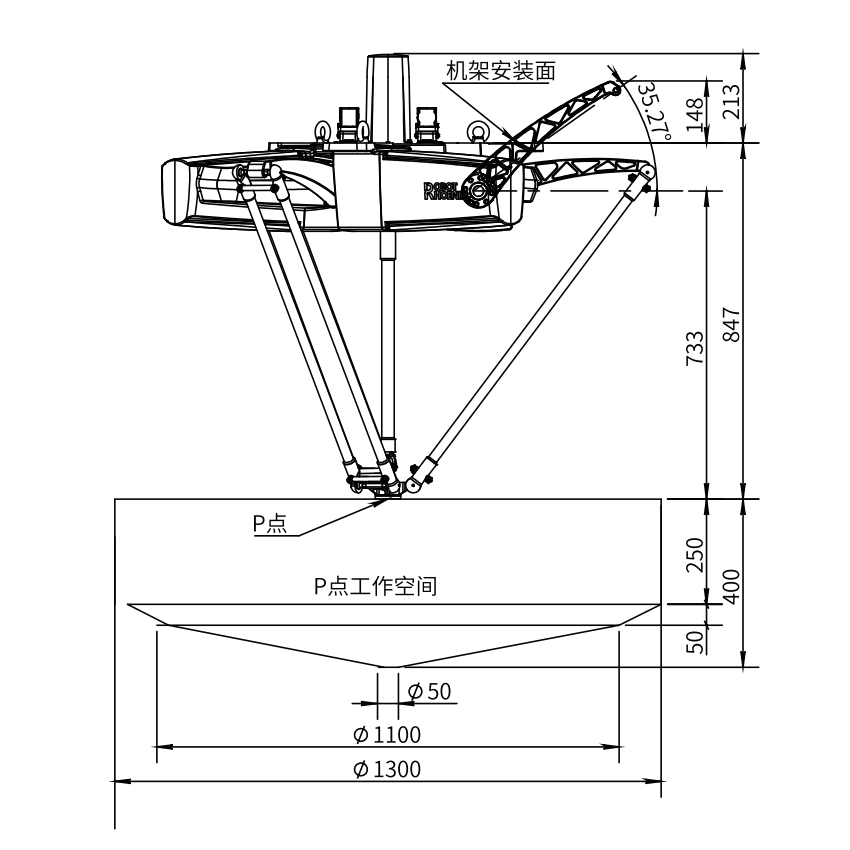
Industrial Robotic Arm Parallel Robot 2/3/4 Axis Delta Robot for Pick&Place Application
A versatile delta platform available in 2, 3 and 4-axis configurations for pick-and-place, sorting and packaging lines that feed a palletizing cell.
Best fit: high-mix end-of-line picking, vision-guided sorting and conveyor-tracked product transfer.
View product details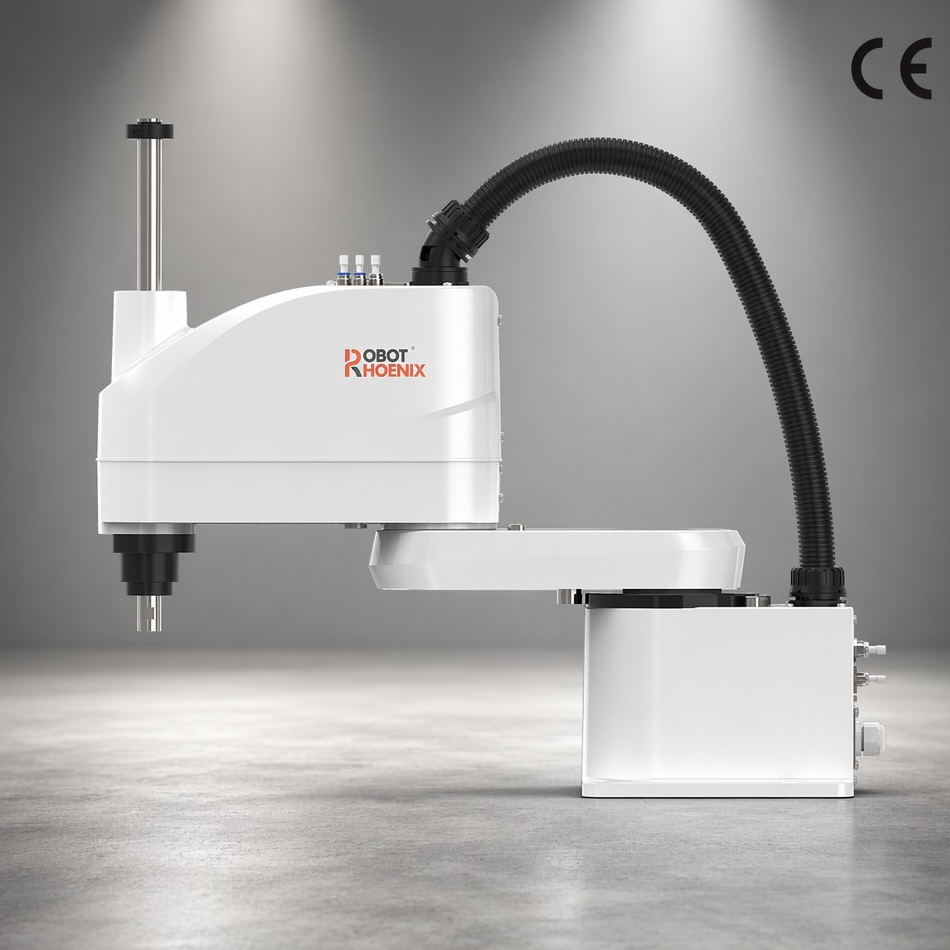
High Efficiency 6kg Payload Manipulator SCARA Robot with Vision for Picking and Placing
A 6 kg payload SCARA with vision for picking and placing. Useful where product orientation, inspection and precise placement need to be handled in one compact cell.
Best fit: small-case palletizing, tray loading, vision-based orientation and quality checks.
View product details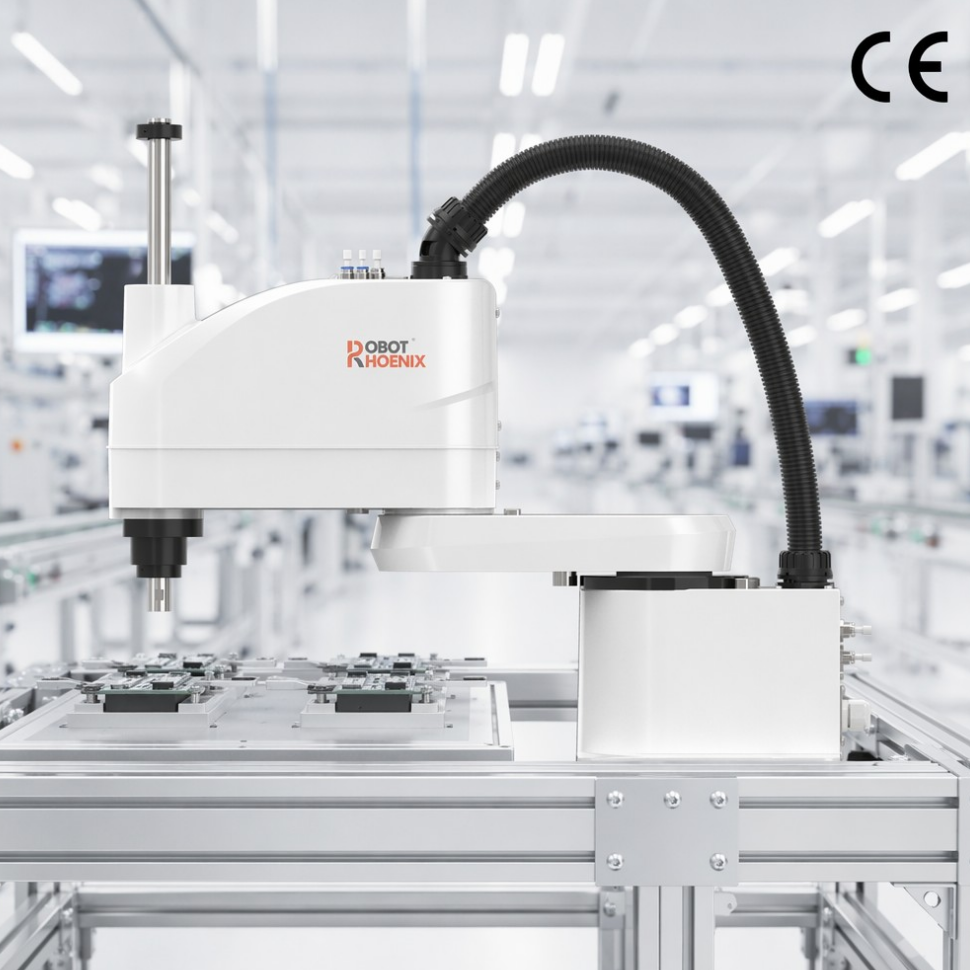
High Speed and Accuracy Newly Developed Industrial Robot Arm Four Axis SCARA Robot
A four-axis SCARA for fast, accurate planar motions in compact production cells, suitable for assembly, case orientation and repetitive end-of-line operations.
Best fit: space-limited cells, high-cycle placement and flexible machine tending.
View product details
High-Speed Spider Arm Delta Robot for Fully Automatic Wet Wipe Lid Applicator Machine
A high-speed spider-arm delta robot for fully automatic wet-wipe lid applicator machinery and other consumer-packaging tasks with demanding cycle rates.
Best fit: wet-wipe lids, daily chemicals, high-speed lid placement and packaging equipment OEMs.
View product details
Newly Design Low Price Industrial Manipulator SCARA Robot Arm with Integrated Motor
A cost-controlled SCARA design with integrated motor, aimed at first automation cells, wholesale projects and OEM equipment where compactness and value matter.
Best fit: lean first cells, space-limited lines, buyer-label projects and scalable palletizing infeed tasks.
View product detailsNeed help matching these robots to a palletizing layout?
Share your case size, payload, pallet pattern, cycle target and line layout. JORI engineers can recommend a robot family, vision approach and material-flow plan.
How to Evaluate China Robot Palletizing System Factories & Wholesalers
The search query “China top robot palletizing system factory and wholesalers” usually combines two buyer intentions: finding a trustworthy factory and comparing wholesale supply options. The strongest supplier is not always the one with the lowest robot price; it is the one that can prove engineering ownership, integration capability and after-sales accountability.
Palletizing automation sits at the end of the production line, where mistakes are highly visible. A robot may be mechanically sound yet fail project acceptance because the case orientation, pallet pattern, conveyor tracking, safety logic or end-of-arm tooling was not engineered as a complete system. For that reason, procurement teams should ask whether the Chinese supplier is a manufacturer, an automation integrator or a trading wholesaler — and who is accountable for the robot, controller, vision, gripper and line interface.
JORI Intelligent Technology Co., Ltd. was founded in 2012 in Jinan, Shandong, China. Its product scope includes delta parallel robots, SCARA robots, AMR/AGV mobile robots, autonomous forklifts and wafer handling robots, supported by in-house controller and 2D/3D vision development, OEM service, design service and automated system integration. That matters for palletizing buyers because the same engineering team can discuss the robot, the controller, the vision system, the material flow and the commissioning logic instead of passing responsibility between unrelated resellers.
When comparing a factory-direct robot palletizing source with wholesalers, separate the quotation into four layers: robot arm and controller, end-of-arm tooling, safety and line integration, and lifecycle support. A wholesaler may be efficient for a standard catalogue robot, but a factory-direct partner is usually better when the project needs custom grippers, PLC-ready interfaces, vision-guided picking, product orientation or AMR-to-palletizer coordination.
- Confirm who owns the robot design, controller software and vision technology.
- Request cycle-time simulation with your real case size, weight and pallet pattern.
- Ask for interface drawings covering conveyors, safety, PLC, HMI and pallet discharge.
- Check repeatability, payload margin, working envelope and infeed product variation.
- Review ISO 9001, onsite verification, patents and export project references.
- Clarify spare parts, remote support, training, warranty scope and acceptance testing.
- Compare total cost of ownership, not only the robot unit price or wholesale discount.
- Validate one cell or pilot line before scaling across multiple palletizing stations.
JORI Intelligent Technology: A Factory Partner Behind the Robot, Controller and Vision
JORI is a high-tech manufacturer specializing in industrial robot R&D and production, controller and 2D/3D vision development, OEM support and automated system integration. For overseas buyers, that combination reduces the risk of a fragmented supply chain.
Founded in 2012, JORI operates from Jinan, Shandong, a national robotics hub in China. The company serves machine builders, system integrators and factory owners across Southeast Asia, Eastern Europe, North America, South America and China. Its original factory model covers delta robots, SCARA robots, AGV/AMR platforms, autonomous forklifts and silicon wafer handling robots, with national patents, in-house controllers, 2D/3D vision, OEM design support and one-stop automation integration.
For palletizing projects, the practical advantage is accountability. The team can support robot selection, end-effector direction, vision logic, controller communication and line integration planning. The company reports a 97.06% response rate with an average response time of 2 hours or less, and standard robots can be ordered from 1 set, allowing buyers to validate a pilot cell before scaling. The factory is located at No. 101 Puyi Jinan Robot Industrial Park, No. 3588 Spaceflight Avenue, High-Tech Zone, Jinan, Shandong, China, and holds an ISO 9001 quality management system credential with onsite-verified supplier status.

In-house R&D
Robot arm, controller and 2D/3D vision development keep core technology under one engineering team.
One accountable source
Hardware, controller, vision, OEM support and integration come from one factory-side team.
OEM & buyer label
OEM service, design service and private-label support for machine builders and wholesalers.
Export discipline
10+ years serving overseas markets, with documented trade records, credit profile and buyer reviews.
Recommended Robot Configuration by Palletizing Project Type
Use this shortlist to start the technical conversation. Final selection depends on product weight, case dimensions, pallet pattern, cycle time, working envelope, safety requirements and existing line interfaces.
| Project type | Recommended starting point | Why it works | Information to send JORI |
|---|---|---|---|
| High-speed food or consumer goods picking | 3–6 kg delta robot with vision and conveyor tracking | Fast lightweight pick-and-place, cartoning and tray loading before end-of-line palletizing. | Product weight, shape, conveyor speed, camera field of view and target picks per minute. |
| Small-case palletizing and tray placement | 4-axis SCARA with vision or 6 kg vision SCARA | Compact footprint, accurate planar motion and straightforward integration into confined cells. | Case dimensions, layer pattern, pallet size, required placement tolerance and gripper concept. |
| Wet-wipe lid and daily chemical packaging | High-speed spider delta robot for lid applicator machines | Designed for fully automatic wet-wipe lid applicator integration and high packaging cycle rates. | Machine layout, lid type, line speed, infeed format and PLC interface details. |
| Pallet and tote transport around the cell | AMR/AGV mobile robot or laser SLAM autonomous forklift | Flexible material flow between palletizer, stretch wrapper, staging area and warehouse without fixed floor routes. | Load weight, route map, pickup/drop height, fleet size, charging strategy and traffic rules. |
| First automation cell or OEM wholesale program | Integrated-motor SCARA robot arm | Cost-controlled platform for pilot deployments, space-limited lines and buyer-label equipment. | Annual volume, private-label requirements, target cycle time and preferred control architecture. |
What Palletizing Buyers Will Expect from China Suppliers Next
Robot palletizing procurement is shifting from “buy an arm” to “acquire a validated production asset”. The following trends are already visible in RFQs from machine builders, third-party integrators and end users.
Verified transparency
Buyers will expect onsite verification, clear factory ownership, product traceability and documented quality records before shortlisting suppliers.
Total cost of ownership
Competitive quotes will include integration, training, spares, software support, energy use and uptime assumptions, not only the robot unit price.
Modular scalability
MOQ 1 set pilot cells, pre-engineered modules and expandable layouts will reduce the risk of committing to a single large line design.
Software as a criterion
Vision, controller openness, PLC interfaces, fleet management and remote diagnostics will be evaluated alongside payload and speed.
Supply chain resilience
Local service partners, spare-parts planning and remote engineering support will matter as much as initial delivery speed.
OEM co-development
Wholesalers and machine builders will prefer factory partners offering private label, custom end-effectors and joint development support.
For procurement teams, the implication is clear: build a supplier scorecard before sending RFQs. Score technical fit, factory ownership, integration experience, response speed, documentation, spare-parts strategy and project references. A supplier that can explain how the palletizing cell will handle rejected cases, missing labels, pallet stacking faults and changeovers is usually more valuable than a supplier that only lists robot specifications. JORI’s factory-direct structure, 2D/3D vision capability, PLC-ready delta robots and AMR/AGV platforms support this more rigorous evaluation process.
Robot Palletizing System Development Trends to Design Into Your Next Line
The next generation of palletizing automation will combine faster arms with smarter vision, compact mechanics and mobile material flow. Designing for these trends now can extend the useful life of the cell.
Integrated motor geometry
Integrated-motor SCARA designs reduce cable exposure and cabinet dependence, supporting compact cells and simpler installation.
Vision-first picking
2D/3D vision, conveyor tracking and AI-assisted orientation are becoming standard for high-mix products and unpacked infeed.
Delta speed plus SCARA precision
Lines will combine delta robots for rapid sorting with SCARA robots for precise placement, giving each task the right kinematics.
Open controllers
PLC-ready interfaces, standard protocols and in-house controllers simplify integration with existing conveyors, safety systems and MES/SCADA.
AMR-to-palletizer flow
Mobile robots and autonomous forklifts will increasingly feed pallets to the cell and remove finished loads, reducing fixed conveyor length.
Safety, hygiene and energy
IP-rated protection, risk-assessed guarding, energy-efficient motion and cleanable surfaces will be part of the specification, not an afterthought.
These development trends favor suppliers who control both robot mechanics and software. JORI’s delta, SCARA, AMR and controller technologies are developed in-house, and the company supports custom end-effectors, controller integration and automated system integration. For a buyer planning a new palletizing line, the strongest approach is to define the product family, forecast changeover frequency and design the cell for future SKUs — then ask the supplier to demonstrate the control concept with a cycle-time and safety review.
Robot Palletizing System Procurement FAQ
Direct answers for buyers comparing China robot palletizing system factories, wholesalers and OEM suppliers.
Are you a factory or a wholesaler?
JORI Intelligent Technology Co., Ltd. is a high-tech manufacturer founded in 2012 in Jinan, Shandong, China. We specialize in industrial robot R&D and production, controller and 2D/3D vision development, OEM support and automated system integration. The company holds ISO 9001 quality management certification and onsite-verified manufacturer status, and serves overseas buyers directly as well as supporting wholesalers and machine builders with OEM options.
What is the minimum order quantity for JORI industrial robots?
Standard delta robots, SCARA robots and AMR/AGV platforms can be ordered from 1 set. This makes it practical to validate a single cell or pilot line before scaling to multiple palletizing stations. For OEM or private-label programs, volume and configuration requirements can be discussed with the export team.
Can JORI customize a robot for a palletizing cell?
Yes. JORI provides OEM service, design service and buyer-label options, and supports custom end-effectors, controller integration and automated system integration. To evaluate a palletizing application, send case dimensions, product weight, pallet pattern, layer pattern, required cycle time, conveyor interface and any special safety or hygiene requirements.
Should I choose a delta robot or a SCARA robot?
Choose a delta robot for very fast, lightweight pick-and-place from moving conveyors, typically 3–6 kg payload. Choose a SCARA robot for planar assembly, insertion, precise placement and compact cells where accurate horizontal motion is more important than ultra-high speed. For end-of-line palletizing, the best choice depends on product format, case orientation, reach, cycle time and whether vision is needed.
Can JORI robots integrate with existing packaging machines and conveyors?
Yes. JORI develops its own controllers and 2D/3D vision, offers PLC-ready delta robots for cartoning machines, and supports machine builders such as wet-wipe lid applicator and carton packer manufacturers. Before quotation, share the machine interface, communication protocol, safety logic and product flow so the engineering team can confirm the integration approach.
Which delivery and payment terms are accepted?
Accepted delivery terms include FOB, CFR, CIF, EXW, CIP, FCA, CPT and express delivery. Accepted payment methods include T/T, L/C, credit card, PayPal, Western Union, MoneyGram and escrow, in USD, EUR, GBP, JPY, CAD, AUD, HKD, CHF and CNY. Final terms are confirmed in the quotation.
What information should I provide for a fast quotation?
Provide product photos or drawings, case dimensions, weight, material, pallet size, layer pattern, required cycle rate, current line layout, infeed method, outfeed method, available space, voltage, air supply, safety requirements and destination country. If you have a video of the current manual process, include it. JORI reports an average response time of 2 hours or less and a 97.06% response rate.
How can I verify quality and supplier credibility?
Review the ISO 9001 quality management credential, onsite-verified manufacturer status, national patents, trade capacity, transaction level, trade history, credit profile and buyer reviews. For technical verification, request the robot configuration, controller details, vision specification, acceptance test plan, spare-parts list and documentation package. A pilot cell or factory acceptance test can further reduce project risk.
Where is the JORI factory located and which markets are served?
The factory is located at No. 101 Puyi Jinan Robot Industrial Park, No. 3588 Spaceflight Avenue, High-Tech Zone, Jinan, Shandong, China. JORI serves Southeast Asia, Eastern Europe, North America, South America and China, with 10+ years of experience serving overseas markets.
Do you support after-sales engineering and spare parts?
JORI supports buyers with factory-side engineering knowledge because the robot, controller and vision technologies are developed in-house. After-sales scope, warranty terms, spare-parts recommendations, training and remote support arrangements are confirmed in the commercial quotation and project documentation so procurement teams can compare suppliers on a clear service basis.
Send Your Palletizing Brief to JORI Engineering
Tell us the product, case size, payload, pallet pattern, cycle target, layout constraints and destination. Our export engineers can recommend a delta, SCARA, AMR or integrated robot-cell approach and reply with the next technical questions.
Factory-direct inquiries: info@joribot.com · Jinan, Shandong, China · ISO 9001 · MOQ 1 set · OEM support