Düsseldorf Sets the Specification Bar for Every Packaging Robot Supplier
Before a single price is discussed, the buyer in this region has already decided which documents, which proof points and which service commitments will be accepted.
Every three years the global packaging industry re-aligns its technical vocabulary at Messe Düsseldorf. The next interpack runs from 7 to 13 May 2026, and the procurement teams who walk those halls — food and beverage co-packers from the Lower Rhine, contract manufacturers from the Bergisches Land, fill-finish plants around Leverkusen and Jülich — arrive with a user requirement specification already written. A robotic packaging system manufacturer who cannot answer that document line by line rarely reaches the second meeting, however competitive the quotation.
North Rhine-Westphalia generates roughly one fifth of Germany’s industrial output, and its logistics backbone sits within a 45-minute drive of the exhibition centre. The Neuss–Düsseldorf inland port handles container volumes that rival many coastal terminals; the A3, A44, A46 and A57 motorways cross the region; Düsseldorf Airport connects directly to more than 180 destinations. For a supplier, this geography creates a specific expectation: spare parts and service engineers are measured in hours, not weeks, and a line that stops on Tuesday afternoon must be producing again before the Thursday shift.
Equally important is how Mittelstand companies buy capital equipment. Price is discussed, but it is rarely the deciding variable. What decides is the documentation pack: a CE declaration-of-conformity route under Machinery Directive 2006/42/EC and, from 20 January 2027, the Machinery Regulation (EU) 2023/1230; a risk assessment that satisfies EN ISO 12100; a safety architecture demonstrably designed to EN ISO 13849-1 performance levels; and a German-language operating manual that a shift supervisor can actually use at 06:00. Buyers also ask for energy data at idle and at full cycle, because industrial electricity in Germany remains among the most expensive in Europe.
Regulation is accelerating change on the line itself. Germany’s Verpackungsgesetz already obliges producers to register packaging in the LUCID register and to fund recycling through a dual system. The EU Packaging and Packaging Waste Regulation (PPWR) becomes applicable from August 2026, tightening recyclability, minimum recycled content and packaging minimisation. In practice the PPWR converts into shorter runs, more SKUs per line and faster changeovers — exactly the parameters where a high-speed delta robot or a compact SCARA cell outperforms a fixed-format machine. Buyers who plan for changeover in minutes, not shifts are already re-writing their specifications.
The labour market completes the picture. German chambers of commerce have ranked skilled-labour shortages among the top business risks for several consecutive years, and packaging is among the most exposed sectors: three-shift manual pick-and-place is hard to staff, hard to retain and hard to quality-control. A robot cell that removes two repetitive positions per shift does not merely cut cost — it removes a structural constraint on growth, and it does so without a recruitment campaign.
This whitepaper therefore does not argue whether a Düsseldorf-area plant should automate. It answers a narrower engineering question: which robot family, sourced how, documented how and supported how, so that the cell is still producing in 2035 without a rebuild.
Eight Packaging Robots Shortlisted for Düsseldorf-Area Lines
A practical shortlist of delta, SCARA and AMR platforms built for secondary packaging, cartoning, lid application and internal logistics. Every model is available from a single set for pilot validation.
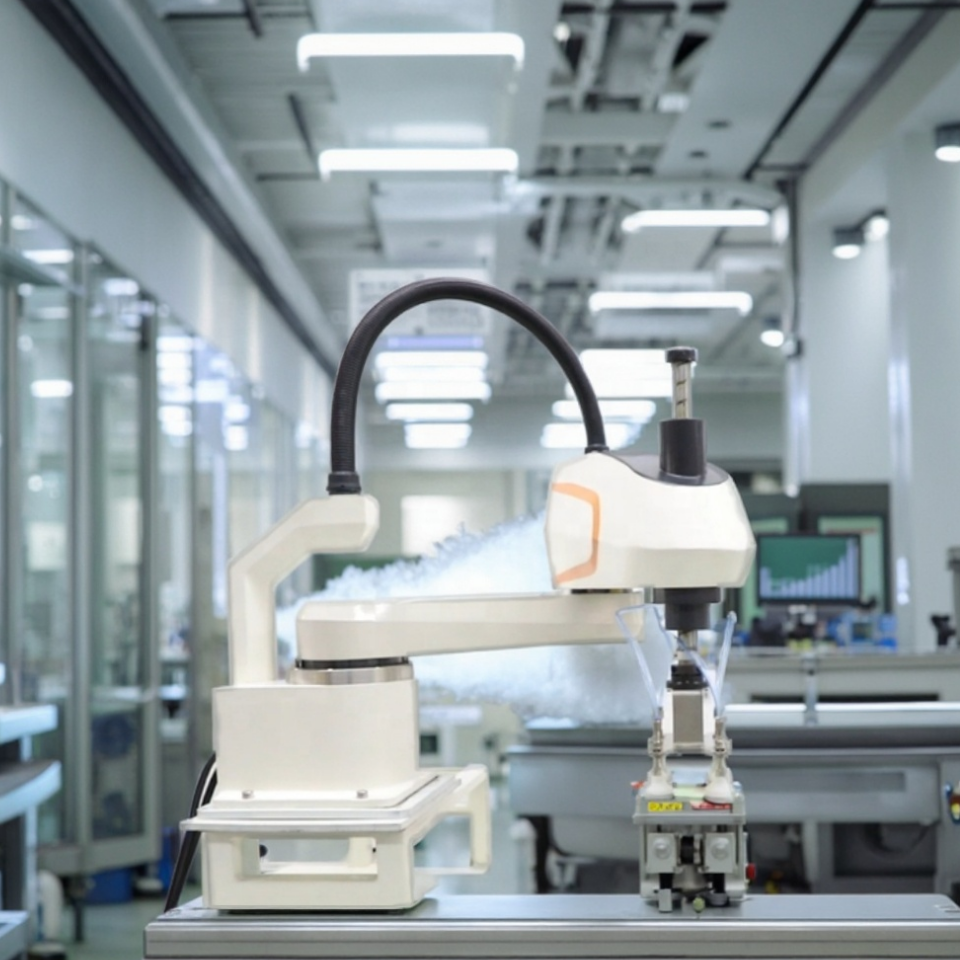
Industrial 4-Axis SCARA Robot Arm with Vision System for Auto Parts
Vision-guided placement for automotive connectors, sensors and trim components.
View product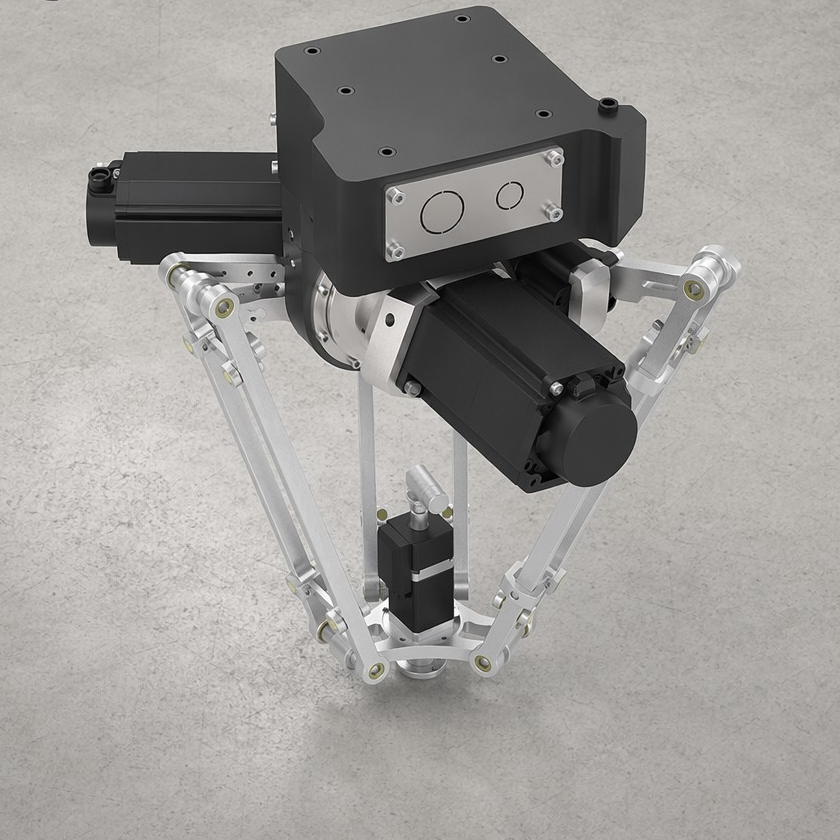
High-Speed Industrial Delta Robot Manipulator for Light Industry
New-condition high-speed manipulator for light-industry pick and place.
View product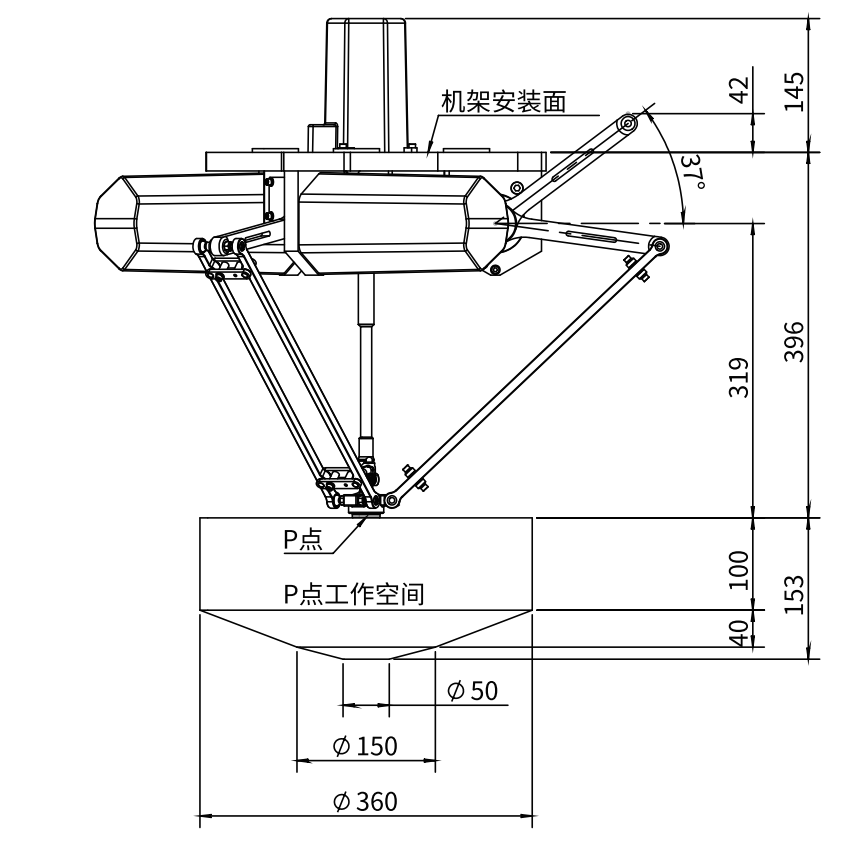
Parallel Delta Industrial Robot Arm for Material Gripping & Sorting
High-cycle gripping and sorting head for conveyor-fed packaging lines.
View product
High-Precision SCARA Robot Arm for Pick and Place in Light Industry
Planar assembly and insertion inside a compact machine footprint.
View product
High-Performance Material Handling AMR / AGV for Warehouse Logistics
Autonomous tote and pallet transport for line-side replenishment.
View product
Low-Price Industrial SCARA Robot Arm with Integrated Motor
Cost-controlled entry point for first-time automation of a manual station.
View product
4-Axis Parallel Delta Spider-Hand Robot for Carton Packer Lines
Direct replacement path for rotary placement heads on cartoning machines.
View product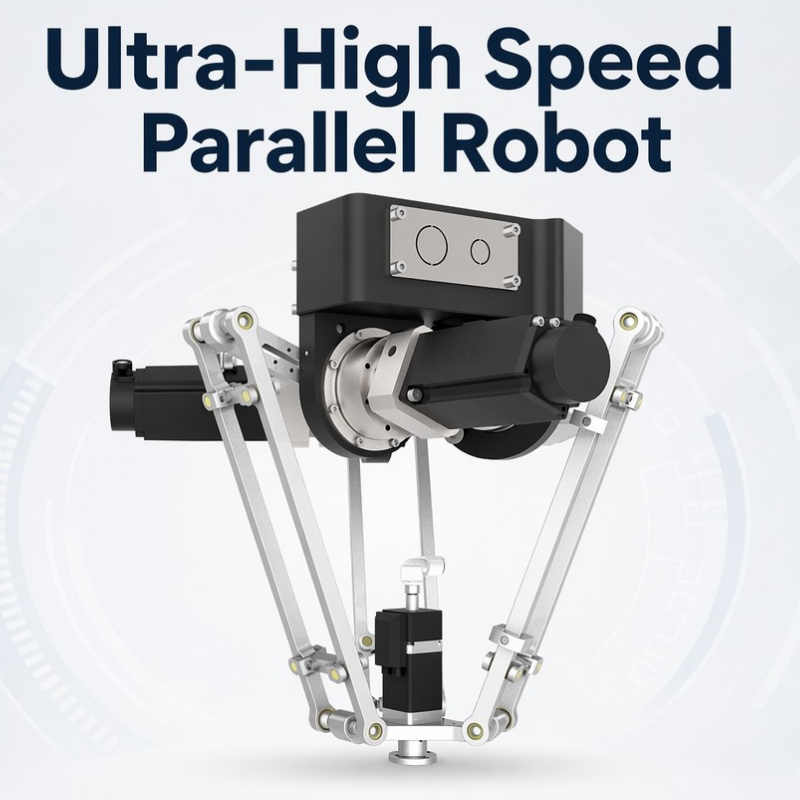
Customised Integrated Delta Robot for Pick, Place & Sorting
Engineered-to-order parallel robot with application-specific end-effector.
View productWhere These Robots Actually Run in a Düsseldorf Plant
Generic case studies hide more than they reveal. These are the six deployment patterns that dominate enquiries from NRW packaging operations.
Food & Beverage Co-Packing
A delta robot mounted over a running conveyor picks dairy cups, baked goods or ready-meal trays at line speed. A 3–6 kg payload covers most secondary packaging, and the IP54 option allows wash-down zones without changing the kinematic platform.
Delta · IP54Pharmaceutical & Medical Cartoning
SCARA cells position blisters, vials and folding cartons with the repeatability that GMP documentation demands. Vision verifies presence and orientation before the plunger closes — a check no mechanical escapement can deliver consistently.
SCARA · VisionCosmetics & Wet-Wipe Lids
Delta-based lid applicator cells place flip-top lids on wet-wipe packs at rates above 100 packs per minute. Because the controller is PLC-ready, the arm drops into an existing applicator frame instead of forcing a complete machine replacement.
Lid ApplicatorAutomotive Tier-1 Kitting
NRW’s automotive supplier base assembles connectors and trim parts in high-mix, low-volume batches. A SCARA robot with 2D vision picks from a mixed tray into a kitting nest, with changeover driven by recipe rather than by physical tooling.
High-MixE-Commerce & Returns Logistics
Laser-SLAM AMRs with 400–500 kg payload move totes between picking zones, packing benches and dispatch without floor tape. Fleet management coordinates traffic in buildings where a fixed conveyor spur would obstruct an escape route.
AMR · SLAMPrinting, Paper & Converting
A 4-axis delta spider-hand robot is the standard answer on carton packer lines: it lifts flat or erected cartons, orients them and inserts product without the mechanical wear that a rotary placement head accumulates over three shifts.
Carton PackingFour Shifts Reshaping Packaging Automation in NRW
Signal strength below reflects how frequently each topic dominates incoming enquiries to our engineering team across the DACH region.
Right-Sized Cells Beat Mega-Lines
PPWR-driven SKU proliferation rewards a 3–6 kg delta or a compact SCARA over one monoblock running a single format. Shorter runs amortise a smaller cell faster and de-risk the capital decision.
Signal: very highRetrofit-Ready PLC Interfaces
Buyers increasingly specify a robot that speaks to an existing Siemens S7-1500 or Rockwell control cabinet, so a delta can be added to a cartoner without rewriting the machine’s validated safety logic.
Signal: highLine-Side AMR Replaces Fixed Spurs
Where a layout is expected to change within three years, a laser-SLAM AMR is cheaper to re-deploy than a conveyor spur that must be demolished, rebuilt and re-validated during a production stop.
Signal: risingCompliance-by-Documentation
From January 2027 the Machinery Regulation replaces the Directive. Suppliers who already hand over a digital technical file, risk-assessment inputs and validated safety parameters shorten the integrator’s CE process by weeks.
Signal: highWhich Robot Family Fits Your Line?
Use this comparison to narrow the shortlist before an engineering call. Final specifications are always confirmed against your part weight, cycle time and layout.
| Robot family | Best fit in a Düsseldorf-area plant | Verified figures | Choose it when |
|---|---|---|---|
| Series 01Delta Robot | High-speed picking, sorting, labelling, cartoning, lid application | 3–6 kg payload · 0.08 mm repeatability · up to 120 pcs/min labelling · IP54 option | Light products arrive randomly on a moving conveyor and cycle time is the bottleneck. |
| Series 02SCARA Robot | Planar assembly, insertion, precise placement, kitting | 4-axis architecture · compact footprint · mini models for cost-sensitive cells | The cell is small and the motion is planar, as in electronics or parts feeding. |
| Series 03AMR / AGV | Tote and material transport between stations | 400–500 kg payload · laser SLAM · smart fleet management | Layouts change, aisles are narrow, or operators spend hours pushing carts. |
| Series 04Autonomous Forklift | Pallet shuttling in warehouses and dispatch zones | Laser SLAM navigation · Camel Series platform | Repetitive pallet moves run across shifts and recruitment is unreliable. |
| Series 05Wafer Robot | Semiconductor and photovoltaic wafer transfer | Self-developed motion control · custom end-effectors | Fragile substrates need smooth, contamination-conscious handling. |
Figures reflect current catalogue models; the binding specification is agreed per configuration in the technical offer.
Why NRW Buyers Shortlist JORI
Six verifiable reasons why machine builders and end users place a first pilot order and then scale.
Controller & Vision Built In-House
The motion controller and the 2D/3D vision stack are developed internally, so a cycle-time question is answered by the engineers who wrote the firmware — not by a distributor.
ISO 9001 Quality Management
Documented inspection from incoming components to final run-in testing, plus third-party verified supplier assessment that procurement can attach to the internal approval file.
OEM, ODM & Buyer Label
Machine builders can integrate a JORI arm under their own brand, with custom end-effectors, controller integration and private-label documentation.
Minimum Order: One Set
Standard delta, SCARA and AMR platforms ship from a single unit, so a Düsseldorf-area plant can validate one cell before committing an entire line.
Capacity Behind the Quotation
More than 500 employees and 10,000 m² of manufacturing space mean a ramp-up does not queue behind a single project or a single production cell.
Two-Hour Response Discipline
A 97.06% response rate with an average reply within two hours, handled by English-speaking engineers; German-language documentation packs can be prepared for handover.
What Düsseldorf Buyers Ask Before the Second Meeting
The eight questions that decide whether a packaging robot supplier advances to a technical review.
Are JORI robots CE-marked and compliant with EU machinery law?
Robots are supplied with EU-compliant technical documentation, declaration-of-conformity elements and validated safety parameters. The final CE mark on an integrated line is issued by the machinery builder or integrator under Directive 2006/42/EC and, from 20 January 2027, Regulation (EU) 2023/1230. JORI supports that file with drawings, risk-assessment inputs and safety data — request the documentation package before price is discussed.
What is the minimum order quantity?
One set. Standard delta robots, SCARA robots and AMR/AGV platforms can be ordered as a single unit, which lets a plant validate a pilot cell or one packaging station before scaling across a line.
How is delivery to Düsseldorf and NRW handled?
Accepted delivery terms include FOB, CFR, CIF, EXW, CIP, FCA, CPT and express delivery. Standard models ship subject to availability; engineered cells are scheduled against the agreed drawing release. State your Incoterm at enquiry stage — DAP Düsseldorf and FCA Shanghai are the two most frequently requested by German buyers.
Can the robot integrate with an existing cartoner or lid applicator?
Yes. PLC-ready delta robots are designed for cartoning machines, carton packers and wet-wipe lid applicator frames, and our controllers and 2D/3D vision are developed in-house, which shortens the interface work on retrofit projects.
Delta or SCARA — which one does my application need?
Choose a delta robot for very fast, lightweight pick-and-place from a moving conveyor, typically 3–6 kg payload. Choose a SCARA robot for planar assembly, insertion and precise placement inside a compact footprint. Send part weight, required cycle time and a layout sketch, and the engineering team will recommend a model rather than a family.
Which payment terms are accepted?
T/T, L/C, credit card, PayPal, Western Union, MoneyGram and escrow, in USD, EUR, GBP, JPY, CAD, AUD, HKD, CHF and CNY. Currency and payment structure are confirmed in the proforma invoice.
Who commissions the cell and trains the operators?
Configuration, programming and remote or on-site commissioning support are provided by English-speaking engineers. German-language manuals, spare-part lists and operator training material can be prepared so the handover file is usable by shift staff from day one.
How quickly do you respond, and what about spare parts?
Average response time is two hours or less, with a 97.06% response rate. A spare-part list is issued with the technical file so a maintenance planner in NRW can hold critical items locally and avoid a line stop waiting on an international shipment.
Specify Your Next Packaging Cell With Verified Data
Send part weight, cycle time, carton format and layout — our engineers return a model recommendation and a documented technical offer.
info@joribot.com